
Kiyomi Osawa
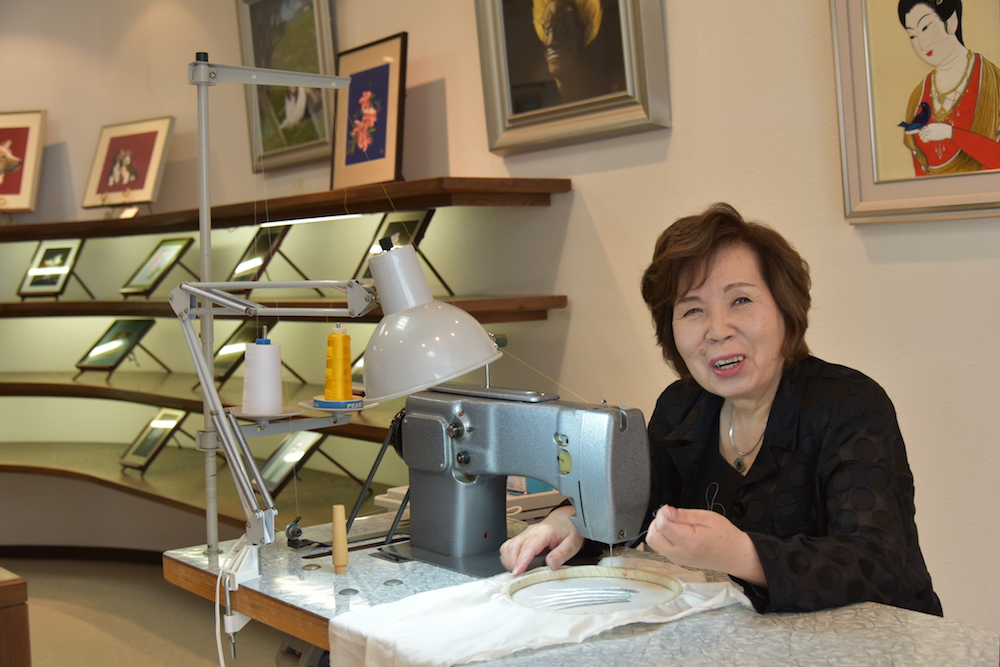
A “Contemporary Master Craftsman” who overcame the loss of his left eye and endured 20-hour daily training. By masterfully operating a traditional yokofuri (side-swing) embroidery machine, he creates intricate pieces that fill every space with vivid portraits and detailed backgrounds. His work captivates designers worldwide. As an incomparable embroidery artist, he continues to weave “beauty,” having transformed the needle into his paintbrush. (Part 1 to 24)
The Sewing Machine Magician: Kiyomi Osawa Episode 1: The PioneerHe became the first embroidery artisan to be honored as a “Contemporary Master Craftsman” and received the Medal with Yellow Ribbon. He elevated the art form of yokofuri machine embroidery—long dismissed as mere “piecework”—to global recognition through exhibitions in places like Paris. Since discovering the artistic potential of the sewing machine at age 17, he continues to forge new frontiers in the world of embroidery.
The Sewing Machine Magician: Kiyomi Osawa Episode 2: A Bridge Between Japan and ChinaIn 1972, shortly before the normalization of diplomatic relations, a portrait of Premier Zhou Enlai, embroidered by Mr. Osawa, was presented to China. The piece, which captured the very “essence” of the Premier, moved him deeply; in return, a precious double-sided embroidery was sent back.
The Sewing Machine Magician: Kiyomi Osawa Episode 3: Portrait EmbroiderySeeking to create “art uniquely his own,” he began tackling portrait embroidery at the age of 19. He established a technique that uses thread to replicate the nuances of light in the eyes and the flow of hair. His skill—capturing not just faces, but the very essence of his subjects, including figures like Sadaharu Oh and Kakuei Tanaka—gained widespread acclaim, leading to his works being presented to notable figures both in Japan and abroad.
The Sewing Machine Magician: Kiyomi Osawa Episode 4: BackgroundMr. Osawa extends his embroidery to the very background of each piece. This is a grueling task, where the slightest deviation in thread direction or fabric tension would ruin the entire work—a challenge he began to pursue in his own unique way at the age of 19. His technique of filling vast spaces with rich, vibrant gradations of color is truly one-of-a-kind.
The Sewing Machine Magician: Kiyomi Osawa Episode 5: Prêt-à-PorterIn the 1970s, Mr. Osawa received a request for embroidery from the world-renowned designer Emmanuelle Khanh. He developed intricate cutwork techniques tailored to the Japanese lifestyle. Resonating with the legendary Parisian artisan Lesage, he became a trusted partner for the world’s most elite designers.
The Sewing Machine Magician: Kiyomi Osawa Episode 6: DesignersHe was trusted by Japan’s leading designers, such as Yoshiyuki Konishi and Kansai Yamamoto, who would tell him, “Only you can do this,” and he became a vital support for their collections in Paris and Tokyo. With his masterful technique and artistic sensibility, he brought complex concepts to life, elevating embroidery to the realm of high art.
The Sewing Machine Magician: Kiyomi Osawa Episode 7: Solo ExhibitionIn 1976, at the “International Art Exhibition” in Otemachi, he was invited to attend and discovered his own works dominating the venue, surrounded by the koto, the tea ceremony, and diplomats from around the world. Despite the loss of sight in his left eye, the “gentleness” he poured into his depictions of Buddha crossed the seas. This marked his first solo exhibition to gain global recognition.
The Sewing Machine Magician: Kiyomi Osawa Episode 8: ParisIn 1993, with the support of embroidery thread manufacturers and others, he held a solo exhibition in Paris. While he engaged with world masters such as Lesage, he found himself visiting the Louvre daily, rather than focusing solely on his own venue. Unattached to authority, what he felt most proud of during his solo exhibition at the Gunma Prefectural Government Building was the handmade easels crafted by his students.
The Sewing Machine Magician: Kiyomi Osawa Episode 9: The Silver SpoonBorn the eldest daughter of a wealthy merchant family in Kiryu, a city renowned for its textiles, she was raised in the lap of luxury. While she showed a rebellious streak against her mother’s strict discipline, she also possessed a remarkable capacity for empathy—even at age five, she had the wit to touch the hearts of the proprietress at a high-end restaurant. This environment, overflowing with opulent “beauty,” cultivated her unique and peerless sensibility.
The Sewing Machine Magician: Kiyomi Osawa Episode 10: PaintingDuring her girlhood, she was far more passionate about tools and baseball than playing with dolls. She received an elite education in the fundamentals of sketching and the expression of light and shadow from a live-in art student, yet she insisted on her own “self-taught” style at school. Her refusal to conform to molds, combined with an unwavering belief in her own sensibility, became the foundation for the highly original body of work she would create later in life.
The Sewing Machine Magician: Kiyomi Osawa Episode 11: The BossKnown as “The Captain” (Taisho) in junior high school, she possessed a charisma that could even calm down local delinquents. Endowed with a protective, boss-like nature inherited from her father and the sensibility passed down from her mother, she declared by the second year of junior high that “formal education is unnecessary.” To pursue her dreams of becoming an artist and designer, she chose to forgo high school entirely.
The Sewing Machine Magician: Kiyomi Osawa Episode 12: EncounterIn the spring of her seventeenth year, her fate changed at an embroidery shop she visited with deep reluctance. Captivated by the way pictures seemed to emerge from the fabric, she intuitively recognized the sewing machine as her “paintbrush.” Resolved to “create fine art with this,” she began showing up two hours before her shift every day to polish her machine.
The Sewing Machine Magician: Kiyomi Osawa Episode 13: 20 HoursIn a world of artisans where skills were strictly “something to be stolen” rather than taught, she spent 20 hours a day facing her sewing machine. Driven by innate artistic talent and sheer tenacity, she surpassed her seniors and claimed the top position in just two months. Even in her dreams, she continued to maneuver the machine, relentlessly pursuing how to breathe life into the eyes of a tiger.
The Sewing Machine Magician: Kiyomi Osawa Episode 14: IndependenceAt 19, she struck out on her own, becoming the production manager leading a team of 20 seamstresses, with her father serving as president. While the business grew rapidly, she felt increasingly conflicted by the daily monotony of sewing “mass-produced” orders. Sacrificing her sleep, she took the bold step toward “portrait embroidery”—a world-first undertaking.
The Sewing Machine Magician: Kiyomi Osawa Episode 15: DissolutionAs the rift grew between her father—who prioritized business management—and her own pursuit of artistic expression, the discovery of bounced checks and mounting debts plunged the company into crisis. In the depths of despair, she walked away from the shop floor to bury herself in her own creative work. In 1972, the sudden passing of her father led to the dissolution of the company. She found herself facing her greatest trial yet, standing at the very edge of the precipice.
The Sewing Machine Magician: Kiyomi Osawa Episode 16: The Third MisfortuneHaving lost her home and assets, she embarked on a new beginning with only her mother by her side. She sought to survive solely through the skill of her hands, relying on her beloved sewing machine, the “GOLD QUEEN.” Yet, a third tragedy struck: retinitis in her left eye. This rare condition, affecting only one in 80,000, robbed the genius of color of her vision, delivering the final verdict of “blindness.”
The Sewing Machine Magician: Kiyomi Osawa Episode 17: To DieWith the healing of her left eye considered hopeless, and her right eye also at risk of blindness, she was consumed by the fear of losing the only means to support her mother, driving her to contemplate suicide. However, she chose to postpone the decision, telling herself, “I will continue until both eyes fail.” She then entered into a grueling battle to hold onto her vision, all while cooperating with research into her rare disease.
The Sewing Machine Magician: Kiyomi Osawa Episode 18: The Compassionate Mother Bodhisattva (Hibo Kannon)While battling the fear of blindness, she reached a profound, bedrock conviction: “Embroidery is all I have.” Just then, she received a commission from a newly established orphanage to create an image of the “Hibo Kannon” (Merciful Mother Kannon). Despite her doctor’s strict prohibition against using the sewing machine, she was moved by the director’s fervent request. She embarked on a new challenge, one that would require her to pour her very life force into the work.
The Sewing Machine Magician: Kiyomi Osawa Episode 19: The Right Eye is Saved!Prepared for the possibility of blindness, she threw herself into the creation of the “Hibo Kannon.” Though her right eye screamed under the strain of the forbidden machine work, she completed the masterpiece over the course of a year. Miraculously, her condition began to improve. Having returned from the brink of death, she was completely reborn as a professional “Embroidery Artist.”
The Sewing Machine Magician: Kiyomi Osawa Episode 20: And, NowEven after sixty years in her craft, she still hungers, saying, “I want to sew even more.” Today, she pours her heart into nurturing the next generation, passing on her techniques and her love for the sewing machine to over 500 students. While she hopes, “I want someone to come along and surpass me,” she herself continues to move the needle, constantly reaching for even greater heights.
The Sewing Machine Magician: Kiyomi Osawa Episode 21: Extra Edition (Embroidery Gallery Finale)As a darling of the media, she has interacted with many luminaries, creating everything from ceremonial aprons (kesho-mawashi) for sumo wrestlers to votive paintings for shrines. The embroidery of “Ebisu-sama,” in particular, harbors the warm memories of the Ebisu-ko festivals she walked with her father in her childhood. Her work continues to be deeply and widely loved, spanning from the stars who color the eras to the sacred rituals of her hometown.
The Sewing Machine Artisan<br>Kiyomi Osawa: Part 1The “Yokoburi” (side-swing) sewing machine, born in Kiryu during the Taisho era, was an ingenious invention to mechanize intricate embroidery. Kiyomi Osawa, a master of this delicate tool, possesses a mechanical intuition that baffles even professional technicians. When persistent technical issues once stumped repairmen, Osawa deduced the cause was a minute deviation in the machine’s horizontal alignment. By mastering such precise balance, she proves that true craftsmanship lies not just in artistic vision, but in a profound, intimate understanding of the machinery that breathes life into her work.
The Sewing Machine Artisan<br>Kiyomi Osawa: Part 2Kiyomi Osawa’s embroidery is inseparable from her identity as a master mechanic. Her works were highlighted at a “Sukajan” exhibition as the soul of Kiryu’s textile craft, and she remains a mentor who personally fine-tunes her apprentices’ machines. This devotion stems from a childhood obsession with tools, where she famously dismantled household clocks to master their inner workings. From repairing her mother’s sewing machine as a girl to ensuring her disciples’ equipment performs with perfect precision today, Osawa embodies a rare synthesis of artistic vision and mechanical mastery—proving that to create life through embroidery, one must first master the soul of the machine.
The Sewing Machine Artisan – Kiyomi Osawa: Part 3Kiyomi Osawa’s mastery of the Yokoburi machine was born from secret observation in her youth. Transitioning from a skilled embroiderer to a self-reliant mechanic, she treats her machines as lifelong partners, personally refining their mechanics and even inventing custom tensioners. She mandates that her apprentices also master machine repair, holding to the conviction: “If you cannot care for your machine, you are no true embroidery artist.” Through this total devotion, Osawa ensures her craft transcends mere needlework.