It was in September 1972 that Japan and the People's Republic of China restored diplomatic relations.
The reckless war instigated by Japan had severed their ties, and after World War II, the communist regime born in China and the long-standing Cold War that divided the world between East and West had continued to prevent "reconciliation." While a peace treaty had been signed with the Republic of China (Taiwan), there was no door through which to travel between Japan and the People's Republic, despite being neighbors; there was not even a small window to call out to each other. Legally, a state of war had persisted until that point.
That abnormal relationship ended with the visit to China by then-Prime Minister Kakuei Tanaka. It was a moment when many Japanese citizens felt the true meaning of post-war peace. A door had finally been opened between Japan and China. In that same year of 1972, Kiyomi Osawa’s embroidery portrait helped nudge that door open.
"Kiyomi, I've been asked to have you create an embroidery portrait of Premier Zhou Enlai,"
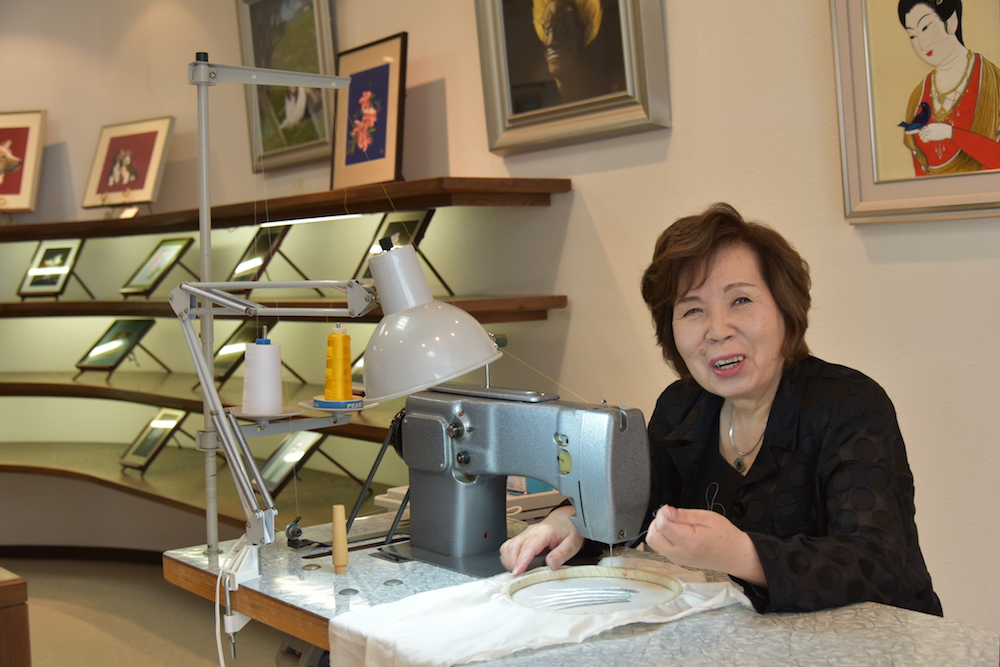
Her father, Touzaburo, said to her. She remembers it was just around the time when the first breath of spring was finally about to visit Kiryu. The work of sewing portraiture using embroidery was something Osawa had started on her own. Eventually, people came to know of it, and she had already been sewing four or five pieces a year upon request.
"Another order?"
She thought, accepting the job lightheartedly. Although her attitude toward accepting it was light, she was fully committed to the work.
First, she needed photographs—and several taken from various angles. Since she was depicting a portrait, it would be meaningless if it did not resemble the subject.
However, Osawa was not a person who simply sewed portraits that looked like their subjects. If all one wanted was a likeness, nothing surpassed a photograph. She believed that since she was drawing a portrait in thread, there was no point unless she could sew the "essence" of the person, which is difficult to express in a photograph. Therefore, she also had to read books about Premier Zhou Enlai. She believed she could not face her sewing machine until she had read and built a solid image of who Zhou Enlai was. That is the kind of embroidery artist Osawa is.
However, this was still an era when there were no diplomatic relations with the People's Republic of China. There were very few magazines that featured photographs of Premier Zhou Enlai. Even when she started looking, she could not easily find any.
Having an idea, she asked a reporter from Kyodo News who had come to interview her previously:
"Don't you have archive photos for reporting at your office?"
He readily agreed, and soon brought her several photographs.
She also looked for books, but found none. It seemed she would have to give up on that front. If so, she would have to draw the person's image solely from the photos she had on hand.
Days spent staring at the photos followed. About a month passed from receiving the order to the time she finally sat before the sewing machine. It took that long to study the photos repeatedly and build her own image of Zhou Enlai. Once she began the work, however, it was fast. It took only about two weeks to finish the portrait, which was about 40 cm by 50 cm.
The photos she had obtained were all in black and white, so she left the colors to her own imagination.
"Since the clothing was a Mao suit, I didn't have much trouble with that,"
She recalled.
Her father, Touzaburo, went to deliver the finished portrait embroidery. It was addressed to Shiro Hasegawa (1905–1986, LDP, Deputy Speaker of the House of Representatives), a Lower House member elected from their local district. It seems her father ended up donating it without accepting any payment—but leaving that aside, why would Mr. Hasegawa be involved with a portrait of Premier Zhou Enlai?
"Apparently, Aiichiro Fujiyama was planning a trip to China, and Mr. Hasegawa was consulted on what he should bring as a gift. That was when Mr. Hasegawa recommended your embroidery."
If that is the case, does it mean that embroidery is destined for China? But she wonders if it’s really true. She can't help but think that perhaps they found a better gift, and my portrait embroidery was simply tucked away, never to see the light of day.
About two months later, a letter arrived from Mr. Aiichiro Fujiyama.
"There is a gift for you from China. I would like to hand it to you, so please come to the Hotel New Japan in Akasaka."
Surprised by the sudden summons, she remembered that the person was a prominent figure who had once served as Minister for Foreign Affairs. Leaving her father, who was bedridden with illness, she and her mother went to the designated location.
"Ah, are you Ms. Osawa?"
Mr. Fujiyama approached them with a smile.
"This is a return gift from Premier Zhou Enlai for your embroidery portrait. The Premier was very pleased,"
He said, handing her a framed piece of embroidery. It was a work sewn using the unique Chinese technique of double-sided embroidery. It was about size 6 (roughly 40 cm by 30 cm) and depicted a girl blowing on the seeds of a dandelion.
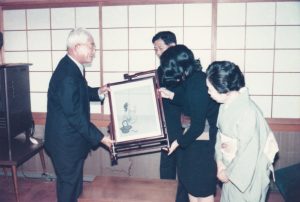
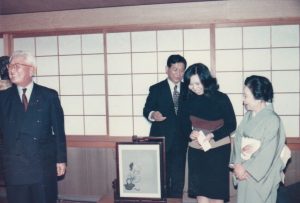
(Ms. Osawa receiving the double-sided embroidery souvenir from China from Mr. Aiichiro Fujiyama (second from the right). On the far right is her mother, Asako.)
She knew that China possessed an embroidery technique that could be appreciated from both the front and the back. It is created by intricately weaving embroidery thread into each individual fiber of a coarse fabric. Because it is a technique that can only be performed by hand, it takes an enormous amount of time to complete a single piece.
"I was so happy, thinking that Premier Zhou Enlai must be someone who understands the heart of an artisan, to have prepared such a precious item as a return gift for me. Of course, I felt deeply honored,"
She said.
A few months later, on September 25, then-Prime Minister Kakuei Tanaka visited Beijing for the first time as a sitting Prime Minister, where he held several meetings with Premier of the State Council Zhou Enlai. It was on the 29th that both leaders signed the "Joint Statement of the Government of Japan and the Government of the People's Republic of China." It was the moment the door that had remained shut was finally opened.
"So, Mr. Fujiyama visited China as a scout for Prime Minister Tanaka, who had begun moving toward the normalization of diplomatic relations between Japan and China."
Everything was something she learned afterward. So, did the portrait of Premier Zhou Enlai, which she had painstakingly stitched, play a small part in the restoration of diplomatic relations between Japan and China? She sometimes hold that question, but no one can give me an answer.
"After that, actually, I tried to challenge myself to see if I could create double-sided embroidery using a sewing machine. I thought it might be possible if I used the same color thread for the top and bottom bobbins. But it didn't work. It really is something that can only be done by hand. China has changed since then, so I wonder if there are any artisans left who can still do that time-consuming double-sided embroidery. I certainly hope there are."
Though she felt honored, her interest inevitably returns to the craft. Kiyomi Osawa is an embroidery artisan through and through.
Kiyomi Osawa Gallery
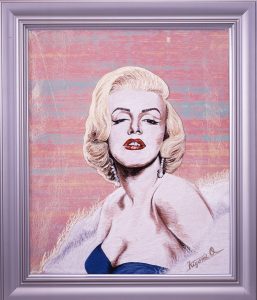
(Marilyn Monroe, as famous as they come. The eyes and lips that seem to beckon men, the wavy blonde hair, and the translucent skin have all been recreated in embroidery.)
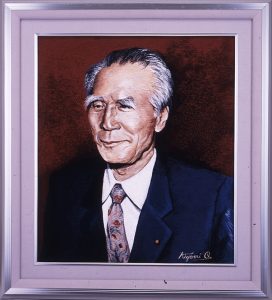
(Who am I?)
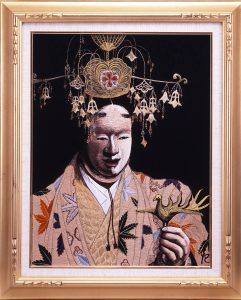
(In Kiyomi Osawa’s mind, this is how Yang Guifei, one of the three great beauties of the world, appears.)
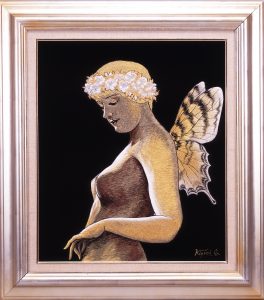
(Fairy)
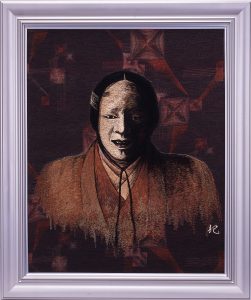
("Yugen" (Profound Grace/Subtlety), a piece that is a particular favorite of Ms. Osawa's.)
コメント