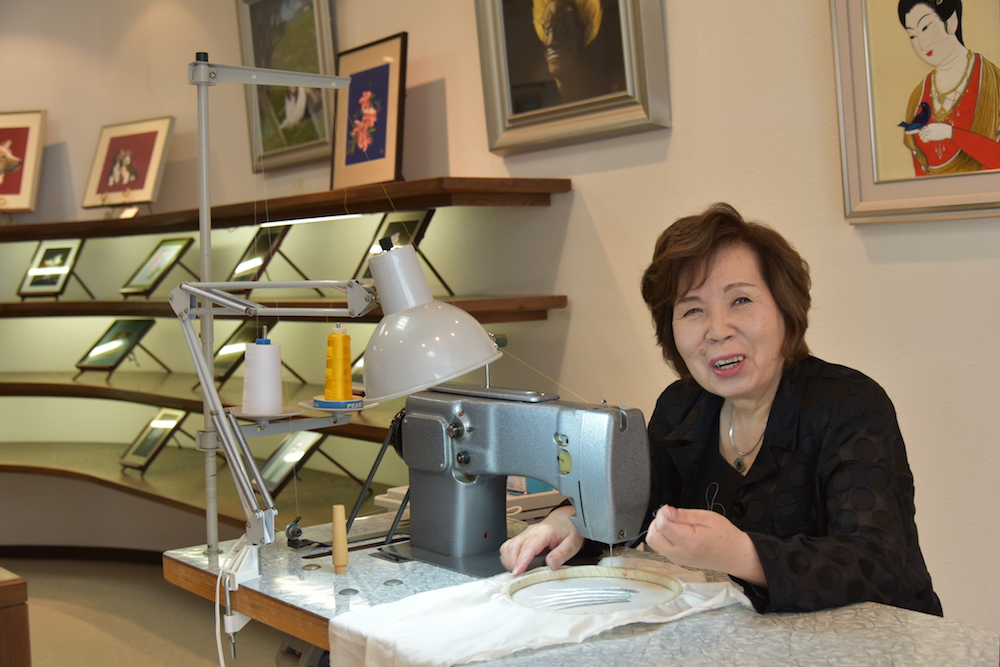
The retina is located at the back of the eyeball; it is the place where images entering through the lens are formed, corresponding to the film of a film camera or the image sensor of a digital camera. Retinitis is a condition where a small hole forms in the retinal pigment epithelium—which protects the retina from unnecessary light—causing fluid to leak and accumulate. Because an obstacle forms in front of the film or sensor, images in that area become distorted, blurred, or invisible. While it often heals naturally, Ms. Osawa's case did not.
At the time, the treatment option was laser therapy: burning and sealing the leaking area to close the hole.
Having already passed the stage where natural healing could be expected, Ms. Osawa underwent this procedure several times while repeatedly being admitted to and discharged from the hospital. She would be anesthetized, and a powerful xenon lamp would be shone into her left eye.
The greatest anxiety a person feels is likely when they do not know the cause of a sickness that has befallen them, and the possibility of a cure remains unclear.
I might lose my sight. Is it even possible to be a yokoburi embroiderer who cannot see? It is impossible. If so, is there anything else I can do? There is not. Then, what should I do…?
Ms. Osawa fell into deep despair and was consumed by anxiety. It was a period when she had just decided to support herself and her mother, Asako, with her own hands.
She told her mother,
"Mother, there is nothing I can do other than embroidery".
She explained.
"When I said that, I wanted to convey that I would commit suicide if I lost my sight. It may have been my own assumption, but my mother seemed to understand my feelings."
To die. Then, how would I die?
Once, when she was visiting a relative who lived near the Tama River, she saw a drowned corpse.
"That was a gruesome sight, wasn't it? I wouldn't want to end up like that, even after death. So, I decided: no suicide by drowning."
She spent her nights in the hospital bed, staring at the wall with her still-functioning right eye and thinking, unable to sleep.
"The nurses came to check on me many times every night. It seems they had to keep an eye on me because it appeared I was going to commit suicide. They seemed to have seen through me."
Drowning is out of the question. On the other hand, she wouldn't be able to get her hands on poison or a pistol. After thinking it over, she decided on hanging.
Once her mind was made up, strangely enough, all sorts of stories about suicide began to reach her ears.
"Hearing them, I realized that suicide didn't seem so difficult after all. Oh, so it’s easy to do, I thought. But then, in the next instant, I decided: in that case, I’ll postpone it until it’s confirmed that both my eyes are completely gone. Am I an optimist, I wonder?"
Life became a cycle of hospitalization and recuperation at home for about a year. It was around that time that she saw someone who had committed self-immolation near her home. It felt as if Death himself was swarming around her.
One day, her doctor said,
"Unfortunately, nothing can be done for your left eye. So, I want to save at least your right eye. However, with current medicine, there is a fear that we cannot save the right eye either. Please keep that in mind".
The doctor's instructions to save the right eye were strict:
・Do not look at passing things.
・Do not read books.
・Refrain from watching television as much as possible.
・Work? Out of the question!
・Please live a relaxed life.
She went for regular checkups. If she was feeling well, she would head home and rest, but if they spotted any bad signs, it was back to the hospital immediately.
"It was a miserable life. The only lucky thing, I suppose, was that the treatment didn't cost me a single yen. Since I had a rare disease, they decided to make me a 'study patient.' I cooperated by drawing pictures of the scenery I saw through my own eyes and writing out detailed accounts of my symptoms. I wonder how many academic papers were written based on my illness? But then, if I hadn't gotten sick in the first place, I wouldn't have had any medical expenses anyway. I guess, back then, that was the only way I could convince myself I was 'lucky.'"
Kiyomi Osawa Gallery
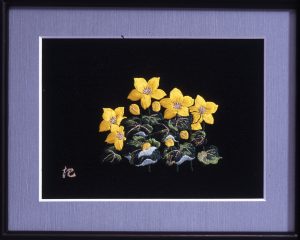
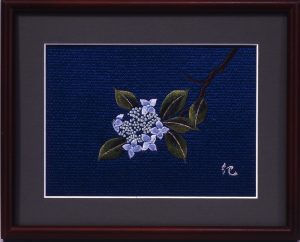
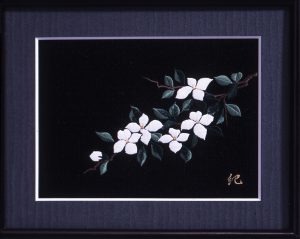
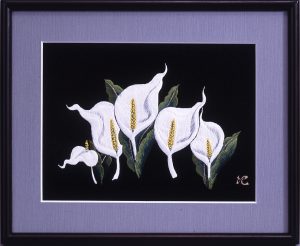
This is the final installment of the "Plants" embroidery series you have enjoyed for so long. Through Ms. Osawa's eyes and sewing machine, flowers and trees that seem to compete for beauty in flower beds, fields, and mountain slopes have been transferred to canvas as further beauty. Did you enjoy the Osawa World?
コメント