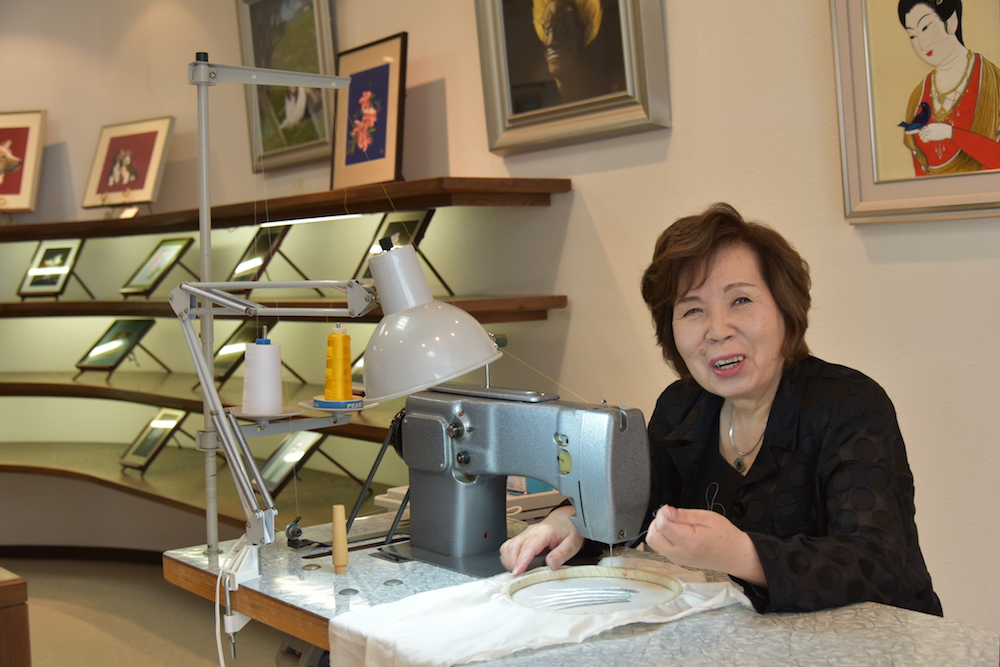
She still vividly remembers the day they met. It was the spring when she was 17.
A few days earlier, an acquaintance of her father’s had come to visit. She had apparently heard the talk that Osawa was not even in high school, and instead, was spending her days entirely engrossed in painting. As soon as she saw her, she brought it up.
"Kiyomi-chan, I hear you're doing a lot of painting, right? You know, I do embroidery. Painting and embroidery are much the same thing, aren't they? Why don't you come take a look sometime? I can teach you if you'd like."
She learned that they were doing piecework, embroidering tigers, eagles, and the like onto sukajan (souvenir jackets).
Even so, she was at an age where she was obsessed with painting. Moreover, she felt that painting and embroidery were similar but fundamentally different. She had done some hand embroidery before, but she had never felt much appeal toward machine embroidery.
The person who offered was likely being kind. However, Osawa-san felt a bit annoyed, wondering,
"Do I really look like I'm just idling away my days?"
Still, since they were an acquaintance of her father's, she couldn't just ignore them. A few days later, she went, albeit reluctantly.
"At that time, my only intention was to pay my respects by showing my face once,"
She recalls.
When she entered the house, located about a five-minute walk from her own, she saw about ten electric sewing machines lined up, with female workers embroidering with intense gazes. It would be some time before she learned that these were called yokoburi (side-swing) embroidery machines.
Right before her eyes, the embroidery came to life. Pictures emerged on plain, featureless fabric. As she watched, she became drawn in. The sewing machine needle began to look like a paintbrush, and the thread passing through it like paint.
"This is it. This is what I’m going to do!"
Before she knew it, she was clenching her fists, screaming inwardly.
"I will draw even better pictures with a sewing machine!"
Perhaps her soul had been stolen by the embroidery works being created one after another.Suddenly, she realized that the sun, which had been high in the sky when she arrived, was about to hide behind the mountains. She had no memory of moving her body during that time. She did not know how many hours she had been standing there, frozen in place.
She stumbled out of the house and, as soon as she returned home, she told her mother,
"I want to do it. I want to learn that work!"
Her head was filled with the embroidered pictures that the sewing machines kept creating.
The next morning, she was taken by her mother to revisit the embroidery shop.
"Please," she said, bowing deeply. "Hire me. Please teach me the work."
She did not know at the time that right after she left, her mother, Asako, had pleaded with them,
"She won't last long anyway. Please, just keep her on until she gives up."
From the next day, she started showing up at 6:00 AM every morning. Work began at 8:00. However, she had decided that before the senior workers arrived, she would clean the workshop and the machines—and for the machines, she wouldn't just wipe off the dust, but also oil them. These were the embroidery machines that would be taking care of her. Was it not only natural that she, who would be in their care, should take care of them?
For the first few days, she just watched the other women work. But Osawa-san was not the type of person to waste time merely watching.
"The way she's sewing that shape is strange."
"She seems to be sewing a tiger, but why make it look like that? That's so clumsy; I feel sorry for the tiger."
She burned every step of the process into her memory, studying to prepare for when she would sew herself, all while viewing the finished works with the eye of a critic. It was incredibly cocky for a complete beginner.
But that is who Osawa is. She would rather die than do the same thing as everyone else. If she was going to do the same task, she would create something far better.
For better or worse, that is Kiyomi Osawa.
The days of observation ended after a few days.
"Kiyomi-chan, would you like to try sewing now?"
The master who had invited her into this world explained how to thread the needle and how to operate the yokofuri machine.
On a yokoburi machine, the needle swings from side to side. You adjust the width of the swing by operating a lever with your right knee. For thin parts of the embroidery, you narrow the swing; for wider parts, you widen it. That said, the maximum width is only about 1 cm, so you overlap threads for wider areas. Actually, sometimes you even overlap threads in narrow areas to achieve a desired texture.
That, however, is hindsight. At the time, what Osawa was taught was simply:
"You thread it like this, and you adjust the needle swing width with this lever here. Yes, you use your right knee."
"Go ahead, give it a try."
Osawa's challenge had begun.
コメント