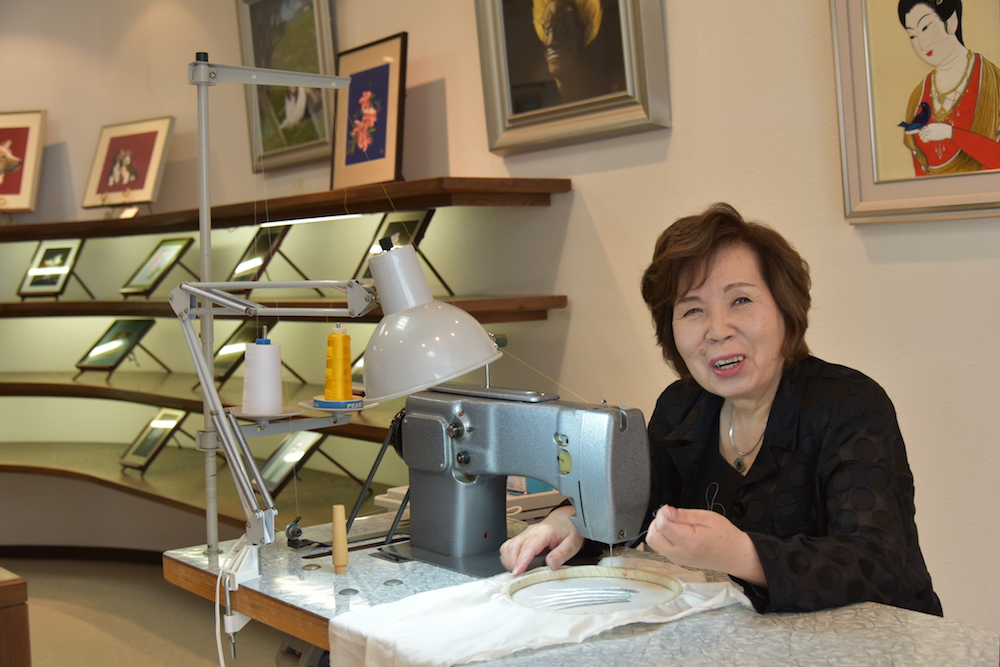
Gendai no Meiko (Contemporary Master Craftsman)
“Gendai no Meiko” is the popular name for the “Distinguished Skilled Workers” recognized by the national government, whose Ministry of Health, Labour and Welfare confers the honor upon those who possess exceptionally superior skills. Every year, 150 individuals are granted this ultimate seal of approval as artisans (the number was 100 until fiscal year 1995), and since the system’s inception in 1967, the total number of recipients through May 2018 is just over 4,000.
To pass through this narrow gate, one must first be recommended by a prefectural governor, a business association, or similar body. The opening of the recommendation criteria states:
“The individual’s level of skill is extraordinary, and they are regarded as the foremost authority in said field domestically.”
Kiyomi Osawa was named a “Gendai no Meiko” in 1994 at the age of 54. It was the first time this award had been presented in the world of embroidery. The certificate and plaque are displayed at the “Shishu Gallery” in 5-chome, Honcho, Kiryu City.
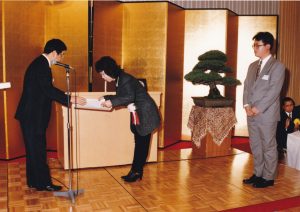
(Kiyomi Osawa was the first person in Japan to be selected as a “Contemporary Master Craftsman” in the field of embroidery.)
As for the 100,000 yen prize money, she remarked:
“Come to think of it, I did receive that money. I believe I donated it to the relief fund for the Great Hanshin Earthquake.”
Two years later, in 1996, she was awarded the Yellow Ribbon Medal. This was also an unprecedented honor for an embroidery artisan.
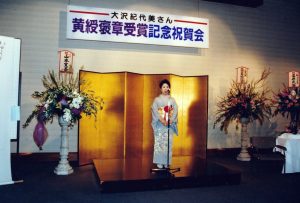
(At the commemorative celebration for the medal, a bouquet from designer Kansai Yamamoto could also be seen.)
“There had been talk of it for a few years before that, but they say it was shelved because people wondered, ‘An embroidery artisan? Why would that be eligible for a medal?’ However, I was invited to Paris in ’93 to hold a solo exhibition. Then, because people thought, ‘Is it really good enough to be recognized in Paris?’, the evaluation suddenly soared, and on top of that, since I had also become a ‘Contemporary Master Craftsman,’ I heard that the award was decided in a dramatic turn of events. Japanese values are susceptible to Europe and titles, aren’t they? I’m sure it’s the same for people who are thought to be incredibly important. I wonder if they have a white-person complex or a title complex. Even if you call it a medal, that’s about the extent of its significance.”
Until Kiyomi Osawa made her mark, embroidery was seen as “nothing more than that.” To put it plainly, it was viewed as little more than a side job for subcontracted artisans. By pushing back against this discrimination and prejudice, Osawa forced those known as the intelligentsia to recognize the value of embroidery, the beauty born from it, and the skills of embroidery artisans, ultimately winning recognition for it as an art form that could not be ignored. She made the possibilities of embroidery visible through her work and stood at the forefront, carving out new horizons for the craft.
“When I was young, someone submitted my embroidery to the Nitten Exhibition without my permission. I heard it was rejected. I could have accepted it if it were rejected because the work was poor, but I was shown the door because embroidery using a sewing machine was not considered a work of art eligible for judging by Nitten. It was a flat-out rejection. I wasn’t interested in it at first, but when I heard the result, I was genuinely frustrated from the bottom of my heart. I swore to myself, ‘Alright, one day I’ll show them.'”
The technique of using a “side-to-side sewing machine” (yokoburi-mishin), where the needle moves horizontally, to create embroidery that looks like a painting is unique to Japan. Although not yet an established theory, it is said to have begun in the Taisho era in Kiryu, where Osawa was born and raised. It was introduced as a means for mass-producing embroidery by machine, replacing hand embroidery. The manual embroidery machine was merely a machine aimed at rationalizing and increasing the efficiency of production.
However, in the eyes of Osawa, who saw the smanual embroidery machine for the first time, it looked completely different.
“I can draw pictures with this!”
That was the starting point of the magnificent “Osawa World.” She was just 17 years old at the time.
More than 60 years have passed since then. In that time, she has literally lived a life dedicated solely to manual embroidery machine. No, even now, she continues to be active, saying,
“I want to create even more wonderful works.”
Many artisans across the country have received instruction from Osawa and inherited the advanced techniques of the side-to-side sewing machine.
I hope you will accompany me in the “Osawa World” for a while.
Kiyomi Osawa Gallery
Although there are many of Osawa’s works, there are few opportunities to see them. Therefore, I will introduce Osawa’s works on this page each time. I have been lent images captured on color positive film by a person who loves Osawa’s work and invested their own money to record them. However, it is difficult to photograph embroidery works. Capturing the texture woven by overlapping threads and the expressions that change with the way light hits them is a daunting task. I must note that the photos posted here cannot convey 100% of Osawa’s world.
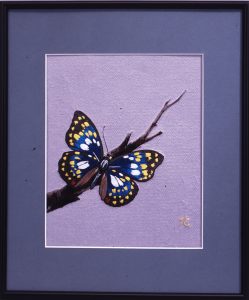 (Great Purple Emperor)
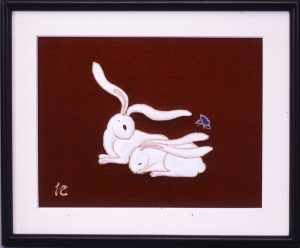
(Sweet)
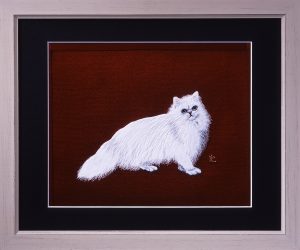
(Chinchilla)
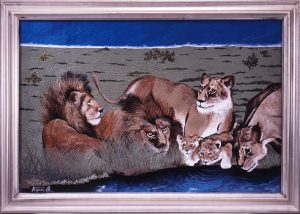
(Family)
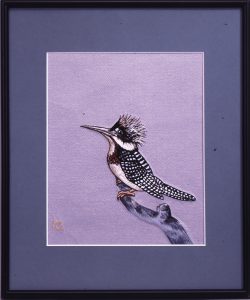 (Pied Kingfisher)
コメント