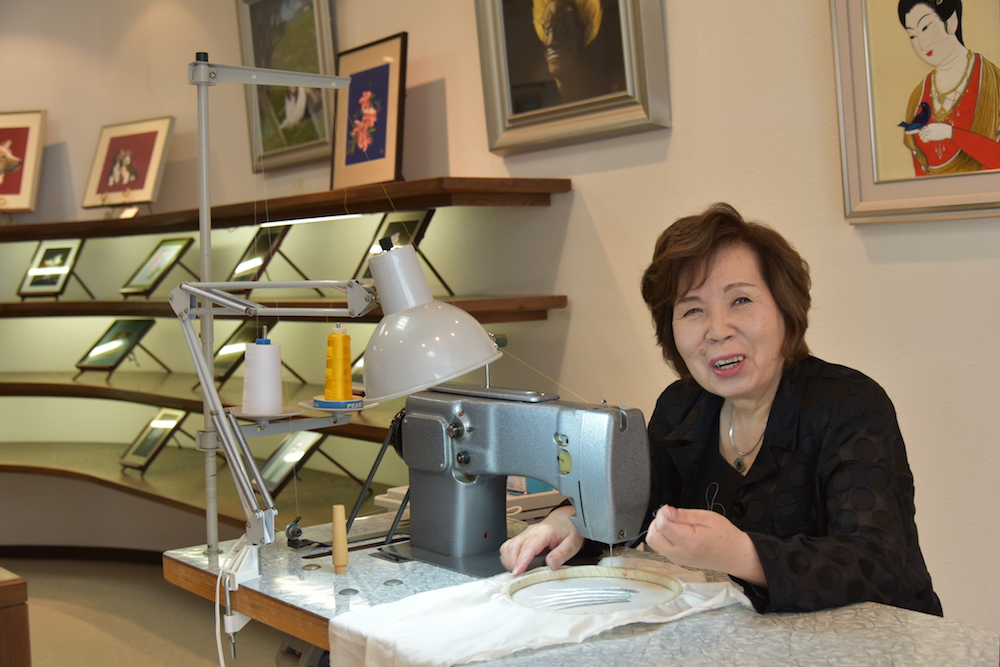
In 2018, Ms. Osawa reached the age of 78. Though she experienced a period of illness about a decade ago, she is now remarkably healthy, spending her days traveling between her home-studio, "Atelier Kiyomi," and her "Shishu Gallery" located on Kiryu’s main street, Honmachi-dori. Naturally, she keeps her beloved sewing machines at both locations.
After all, more than half a century has passed since she was first enchanted by the yokoburi sewing machine at the age of 17. She has even surpassed the 60-year milestone. By all conventional standards, it is about time for her to settle down. So, I asked her:
——What would you like to do from here on out?
"I want to sew more. I want to create more and more works that are distinctly 'mine.' And, well, I wouldn't mind becoming a bit more famous, and yes, I would like to make more money, too".
She is just like a 20-year-old up-and-coming embroidery artist. While her body has aged, Ms. Osawa’s heart has not withered in the slightest. Forever Young. Perhaps the artistic energy bursting from within her is simply too powerful to age in step with her years.
Currently, Ms. Osawa is focusing her efforts on nurturing the next generation, feeling it is her responsibility to train embroidery artists who can follow in her footsteps and eventually surpass her.
However, perhaps it is the times. In this one regard, things simply do not go as she wishes.
It was around 1990 when she began teaching young people who wanted to hone their embroidery skills. She was asked to be an instructor for a professional embroidery class organized by a sewing machine manufacturer based in Omiya City, Saitama Prefecture. As she recalls, ten people from all over the country gathered for the first session, bringing their own beloved sewing machines.
"They said they dismantled their beloved sewing machines and had them air-freighted. I couldn't help but feel sorry for them, wondering how much it must have cost—the shipping fees surely far exceeded the tuition,"
She said.
Though there is no definitive consensus, it is said that embroidery using the yokoburi (swing-needle) sewing machine originated in Kiryu. Many of the artisans using yokoburi machines across the country are people who learned in Kiryu—and were invited to move to their current locations because of their recognized skill—or their descendants.
"But those who left Kiryu continued their embroidery entirely on their own, so over time, it became their own unique, self-taught style. The young people who took over that work only knew how to use the machine exactly as they had been taught, so I suppose they wanted to learn the genuine techniques of embroidery from an artisan in Kiryu, the birthplace of the craft."
There was one young man who startled Ms. Osawa. He placed a homemade-looking box under his sewing machine and began to sew with his right foot resting on it. The right foot is meant to operate the lever that adjusts the needle's swing width.
"Why are you resting your right foot on a box? It must be difficult to work in that posture."
In response to Ms. Osawa’s question, the young man replied,
"My old man did it this way."
The swing-width adjustment lever can be moved up and down to match one’s physique. Therefore, a footrest is unnecessary, yet it seems this young man’s father did not know that. When he placed his right foot on the floor, his right knee could not reach the lever. So, he had used a box to raise his foot and operate the lever. That habit was passed down directly to his child.
"Look, this lever moves up and down if you do it this way. You must adjust it to your own physique."
It was an exchange that sounded almost like a joke. Yet, thanks to meeting Ms. Osawa, this young man learned the correct way to operate the machine.
"There are countless stories like that."
There is a correct way to use any tool. The correct way is also the method that causes the least fatigue and allows for the best possible embroidery.
Following this, Ms. Osawa became highly sought after as an instructor everywhere. She was requested by other sewing machine manufacturers, embroidery associations in various regions, prefectural vocational training schools, and by aspiring students who would travel all the way to Kiryu to study under her.
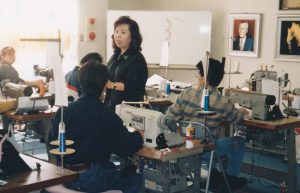
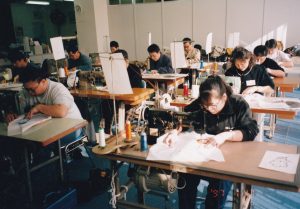
(Young people learning enthusiastically at "Osawa's Class." Will embroidery artists who surpass Ms. Osawa emerge from here?)
Ms. Osawa makes it a rule to teach every student from the very basics. This is because even those who are already working professionally in embroidery are surprisingly ignorant of the foundations.
The double embroidery hoop has a metal screw on the outer frame, which is used to adjust the tension of the fabric.
"Listen, you must place this screw at the 2 o'clock position."
When setting fabric into the hoop, you pull it vertically and horizontally to stretch it taut. If the screw is at the 12, 3, or 6 o'clock position, there is a risk that it will snag the fabric and tear it.
"Why do you think sewing machine needles break?"
This is also a standard question she asks her students. Students who continue to break needles over and over again cannot answer.
"Needles may seem rigid, but they flex slightly when they strike the fabric. If you forcibly pull the fabric while the needle is flexed, the bent needle strikes the metal parts underneath. That is why they break. You must never place undue stress on the needle."
Ms. Osawa’s love for the sewing machine is absolute. This, too, must be conveyed to her students.
"Hey! You shouldn't be eating yet. The sewing machine is what puts food on your table. If that's the case, isn't it only natural that you should oil the machine before you eat your own meal?"
The number of students who have received Ms. Osawa’s teaching has already exceeded 500. While contact has been lost with many, they are surely working on their embroidery today in their own places.
"I will teach them everything I know. That is why I want a student to emerge as soon as possible who will surpass me."
However, Ms. Osawa once fought with her sewing machine for 20 hours a day, forging her path by casting everything else aside. Now is an era filled with many temptations. Will a young person emerge who can pour all of their time into embroidery and stand shoulder-to-shoulder with Ms. Osawa?
Kiyomi Osawa Gallery
This gallery marks our final installment. We conclude by showcasing a collection of embroidery works that are not housed in frames.
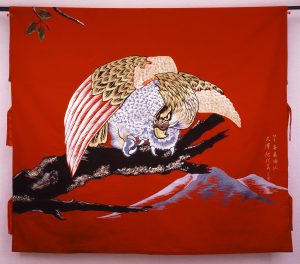
(Embroidered Festival Float Sash)
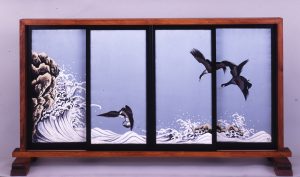
(Untitled)
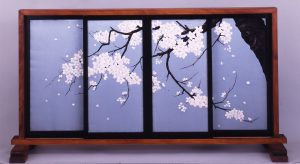
(Untitled)
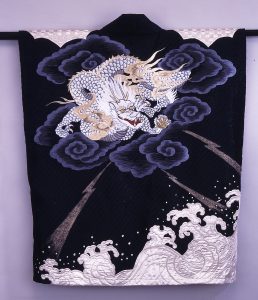
(Thundercloud)
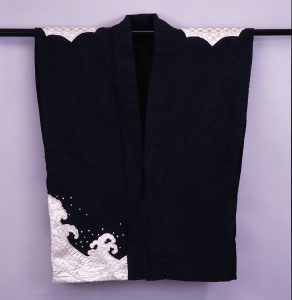
(Flying Dragon)
コメント