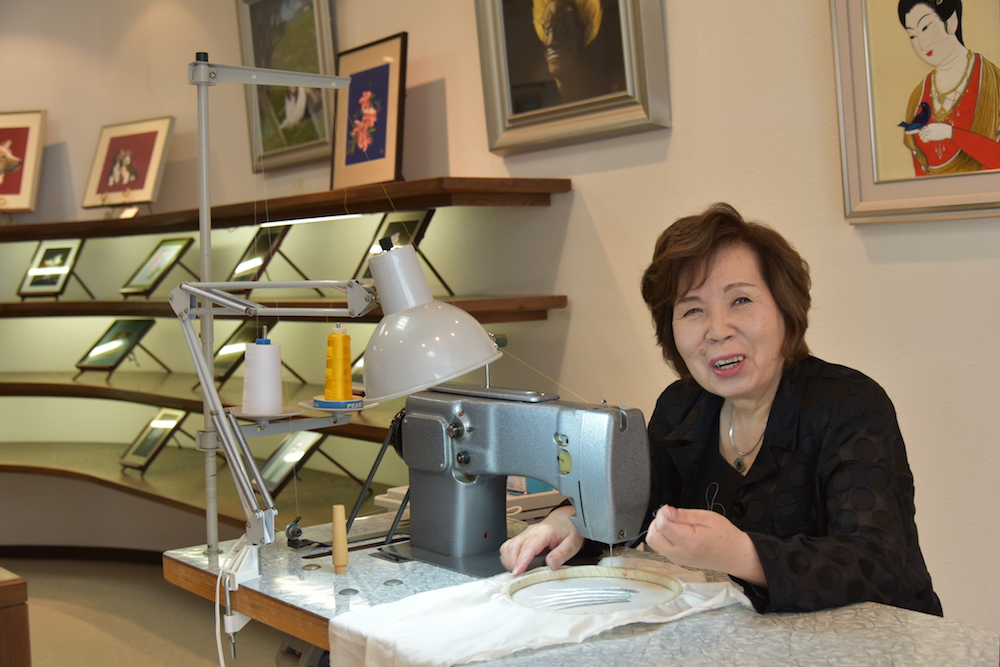
She recalls it was in the autumn of 1975 when Ms. Osawa received a letter from a stranger. Although she had been turned away from the prestigious Nitten exhibition, she was beginning to be recognized in the world as a "hidden gem" of an embroidery artist. She had also started to receive sudden letters from unknown sources.
Looking at the sender, she saw the name of a foundation she did not recognize, along with the name of an individual who seemed to be the sender.
"What could this possibly be about?"
She wondered, opening the envelope with suspicion.
"I have seen your work. It is magnificent. I am currently preparing an art exhibition and would very much like for you to exhibit your work."
Even so, she could not simply agree on the spot to a request from a complete stranger.
"I would like to meet you once to hear the details,"
She replied in a polite letter, then traveled to Tokyo according to the other party's schedule. Upon hearing their story, she learned that the person had spent many years working abroad.
"Japan, which plunged into the abyss after embarking on a reckless war, rose from rock bottom to achieve economic growth dubbed a 'miracle.' Our economic power is now on par with the developed nations of the world, yet I feel few foreigners truly understand the real beauty of Japan. Having realized this during my long life overseas, I retired and established this foundation to introduce Japanese beauty to the world. Your embroidery is a form of beauty that Japan can be proud of. I want people all over the world to see it. Would you be willing to cooperate?"
The person was not a man of many words, but each word he squeezed out carried immense weight. She learned that through his previous activities, he had developed deep ties with ambassadors from various countries, and he expected many of them to attend the exhibition.
Ms. Osawa found herself answering immediately.
"If my work is good enough, then yes, please. Let me exhibit it."
She would not receive an "exhibition fee" for displaying her work. It was not an exhibition where items would be sold on the spot. It was a voluntary, unpaid contribution.
However, the organizer's words struck a chord in her heart. Moreover:
"There was no one called an 'artist' among those who embroider with sewing machines. My work wasn't recognized as art. That is why I wanted more people—people all over the world—to know that beauty can be created even with machine embroidery."
In the spring of 1976, an "International Art Exhibition" was held in Otemachi, Tokyo. Ms. Osawa, who had lent five or six pieces, arrived before the opening as she had been asked to give a speech on the first day.
"I was taken aback when I entered the venue. There were only my works. I had been convinced it would be part of a collection of at least dozens of pieces, so I was stunned."
The room was likely used for parties, as it was covered in thick carpeting. Naturally, her embroidery pieces were displayed on the walls, but a section of the venue was also covered with mousen (red felt), with preparations made for a tea ceremony. Several koto (Japanese harps) were lined up in front of the main embroidery painting.
Before long, the doors opened. Soon, the venue was filled with about 100 guests. About a third were foreigners, with English and French flying through the air. Judging by their attire and demeanor, most appeared to be the wives of diplomats or politicians.
The tea ceremony began on the felt rug. The sound of the koto began to flow from in front of the main embroidery piece. Once that came to a pause, it was time for Ms. Osawa's speech.
She cannot remember exactly what kind of speech she gave that day. However, she does remember that many questions were thrown at her once she finished.
Many of the exhibited works were of Buddhist statues.
"There are many Buddhist statues. Are you a religious person?"
—No, I am not a follower of any specific religion. However, I suffered an eye ailment at the age of 32, and I can no longer see out of my left eye. Since then, I have been drawn to Buddhist statues for some reason. I have also visited many temples in Nara and Kyoto. The prevalence of Buddhist statues is a reflection of my current state of mind.
"Even so, these embroidery paintings convey a gentleness to the viewer."
—My mother was a person who, even when picking wild flowers in the field, would say, "Forgive me," before doing so. Perhaps I have been influenced by that.
"I know embroidery done by hand, stitch by stitch, but I never knew such wonderful embroidery could be done with a sewing machine. Japan has amazing technology. How did you acquire this skill?"
—In Kiryu, many such skills are still alive.
"In the end, it was my first solo exhibition held in the capital. A solo exhibition opened to the world, at that. Because of this, my memory of it is clear. I had thought the organizing foundation was the 'Asia Art Association' and the venue was the Otemachi Press Center, but when I searched online beforehand to talk to you about it, neither came up. Perhaps my memory is scrambled. Oh, getting old is such a dreadful thing."
Kiyomi Osawa Gallery
Based on the flow of our conversation, this time I would like to show you her "Buddhist paintings." The author has 10 images on hand, so please enjoy the first five.
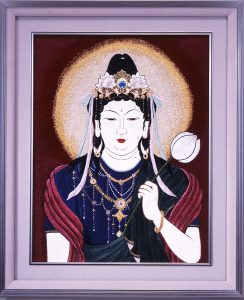
(Kannon Bodhisattva)
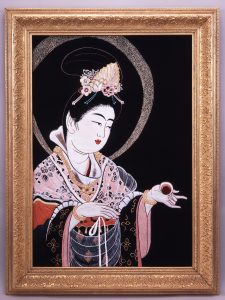
(Kisshōten)
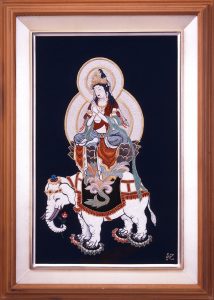
(Fugen Bosatsu)
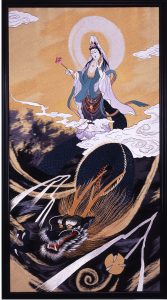
(Ryū Raigō-zu (Dragon Descending Amidst Thunder))
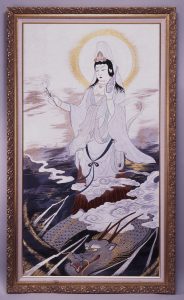
(No Title)
コメント