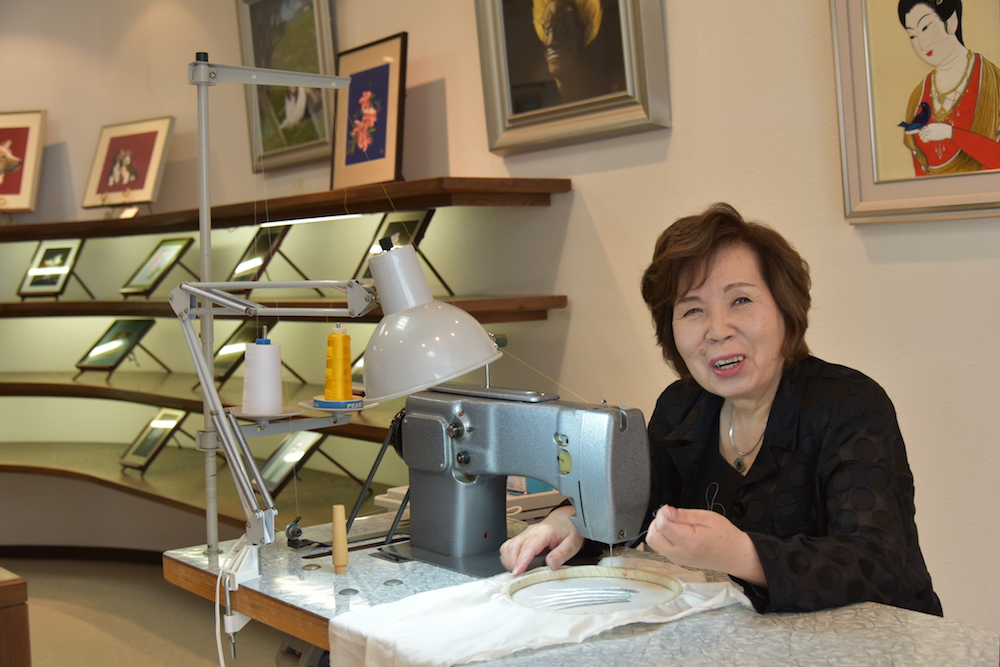
"I think I'll try embroidering a portrait."
The thought occurred to her at age 19. As I will touch upon in detail later, Osawa had already founded a company with her father, Touzaburo, as president at this time. The business was going well, and with dozens of employees to look after, she was busy with work from 6:00 AM until 1:00 or 2:00 AM every day; it was a time when she had almost no free time to call her own.
Even so, she stole moments to sit at her sewing machine. It was because she felt unfulfilled by embroidery that was merely stitched at the behest of clients.
She wanted to sew her own "work." She wanted to create.
She had loved drawing since she was a child, and there was a time she wanted to become a painter. Therefore, even after she started her embroidery business, no matter how busy she was with work, she would pick up a paintbrush whenever she had a little spare time. Perhaps it was because she was still a girl, but she often painted actresses. What would happen if she replaced that paintbrush with a Manual embroidery machine?
Osawa has an insatiable spirit of inquiry.
The first person she challenged herself with was Kim Novak. A Czech-American, she radiated bewitching beauty in films such as Alfred Hitchcock’s Vertigo and The Eddy Duchin Story, which depicted the life of the jazz pianist.
"I liked her cool vibe."
She had been hooked on movies since junior high school, watching two every week.
She developed her ideas while looking at gravure photos in magazines.
"The key, first of all, is the 'eyes.'"
The eye color of Westerners varies. Kim Novak had deep, translucent green eyes.
"That color changes depending on how the light hits it. You can never capture that change in a painting. But you can with embroidery; if you devise the direction and layering of the threads, embroidery is something where various colors emerge depending on the light."
Next was the hair. Her hair was a light gold, or what is called "Dyed Blonde" in English.
"With that color, the waves really look magnificent. You absolutely can't get that feeling with the black hair of a Japanese person."
Hair has a flow. She expressed the flow of each individual strand of hair with embroidery thread. Because hair also shows different hues depending on how the light hits it, she also put great effort into how the threads were layered.
She did not start portrait embroidery with the intention of making it a job that would earn money. For Osawa, the goal was to devise new side-swing embroidery techniques and to give birth to the embroidery she wanted to create. She only chose portraits because she thought it would surely be more fun if she intertwined it with her hobbies.
She continued to produce portrait embroidery, stealing time to do so. She wanted to make it so that the raw humanity of each different model could be seen…
"Kiyomi, an order for a portrait embroidery has come in."
Her father, Touzaburo, said suddenly. It seems he had taken her portrait embroidery without permission and was using it for sales, saying,
"Kiyomi can do things like this, too."
She had started the embroidery without any intention of making it work. However, she was still happy when an order came in. The client was a company executive in Kiryu City. He wanted her to stitch his own portrait in embroidery. She went to meet him, had many conversations, borrowed his photos, and sat at her sewing machine.
Since then, orders for portrait embroidery began to come in incessantly.
Around the time she was 22 or 23, she stitched the first American president, George Washington, as a gift for a local economic organization going on an inspection tour abroad.
The clients were not just people from within the city. From somewhere the word spread, and she also received orders for portraits of the professional wrestler Rikidozan, the professional baseball player Sadaharu Oh, and the kickboxer Tadashi Sawamura. They were all requests from fans.
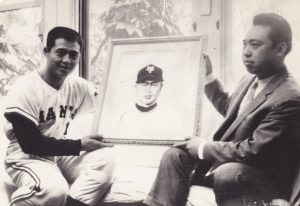
(The portrait embroidery presented to Sadaharu Oh)
Some people would place orders to have portraits of the late President John F. Kennedy embroidered, saying they intended to donate them to the American Embassy. Who was it that commissioned the portrait of Elvis Presley?
"There were many politicians, too,"
She said.
Hayato Ikeda, Takeo Fukuda, Eisaku Sato, and Kakuei Tanaka…
Taking advantage of the interview, I asked her:
"Who had the best face?"
Osawa is an artist who does not move her sewing machine until she feels she has seen the essence of the person she is depicting by viewing their photographs and videos and thoroughly reading books about them. It was not entirely wide of the mark to ask her for an evaluation of "faces."
"Oh, that would be Tanaka-san,"
She replied immediately.
"His face showed his way of life—or perhaps the energy a person possesses, or the power to capture people's hearts—it was a face where those things came straight through,"
She said.
Recently, orders for portrait embroidery do not come as often. Even when she is asked, she declines as much as possible. The direction of her interests has shifted.
Even so, the techniques she acquired while trying to capture the essence of a person with sewing machine needles and embroidery thread live on in all of Osawa's works.
Kiyomi Osawa Gallery
This time, we would like to introduce embroidery featuring birds.
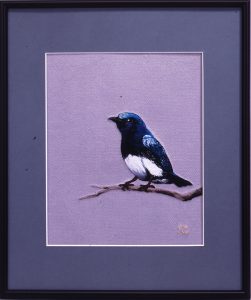
(This embroidery has no title.)
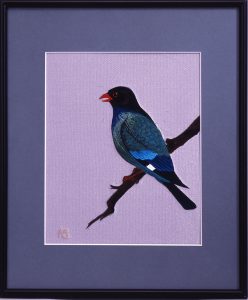
(This one, too, is untitled.)
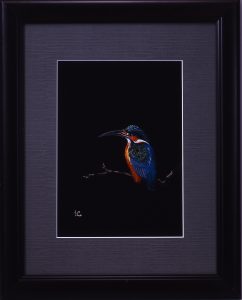
(She has named this piece "Seifu" (Pure Breeze).)
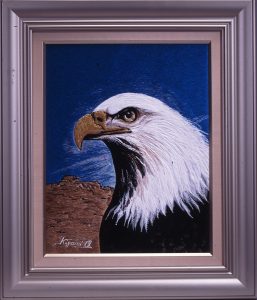
(Bygone Days)
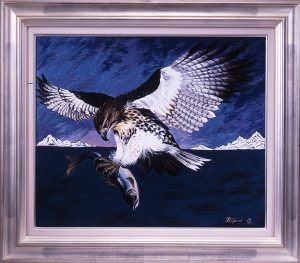
(The Struggle.)
コメント