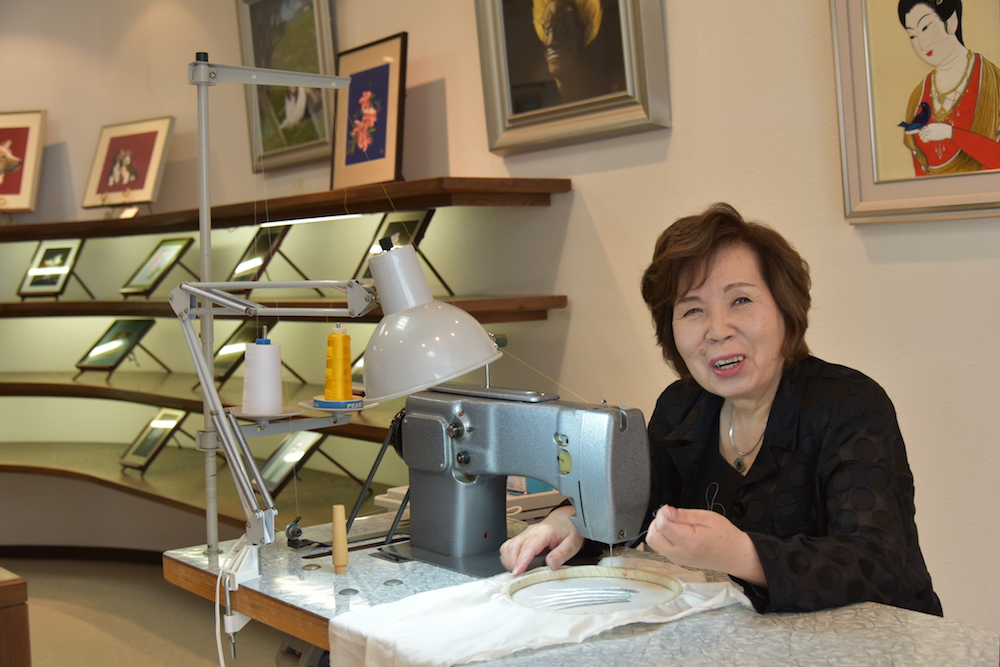
"I must save my right eye at all costs."
This battle continued for another year and a half, a period defined by the same grueling cycle of recuperation at home and hospitalizations whenever her condition worsened.
For Ms. Osawa, this was not merely a struggle to retain her sight; it was a desperate fight between choosing to live or choosing suicide.
Yet, even in the midst of this life-or-death battle, an irrepressible passion for art and embroidery bubbled up from deep within her.
"For the first year, I was drawing. Before I knew it, I’d find myself opening a sketchbook and holding a pencil. If my doctor heard that, he’d probably think I was a hopeless patient."
As she moved her pencil, Ms. Osawa began to change, little by little. The first thing that arrived was a detached, cynical view of life.
"I started feeling as if my life had already been decided. And then, the fact that I—or anyone else—was alive began to feel strangely distant. Things like 'this is how it is,' 'that's how it is,' or 'someone said this, someone did that'… it all started to seem so trivial."
So, what was this life of hers that she viewed from such a distance?
"As I started thinking about that, I realized from the bottom of my heart: 'Ah, I’m in love with embroidery.' I realized I had nothing but embroidery. When I fell ill, I did wonder if there was some other good, easier job out there. After all, a part of me felt I had to support my mother. But no matter how much I thought about it, embroidery was all I could do. It had to be embroidery. Without embroidery, I couldn't live. Of course, to those around me, I’d always been someone who only did embroidery. But it was only after I got sick that I understood, deep in my core, just how much I loved it. I was madly, truly in love with it."
It was right in the middle of her battle to save her remaining right eye—having already lost her left—that the director of "Kane no Naru Oka Aiseien," a children’s home at the foot of Mount Akagi, which the people of Gunma love so dearly, visited her at her home in Kiryu.
He was someone she had never met before. He appeared to be around sixty. His clothes were rather shabby, and his shoes were caked with mud. Yet, as he spoke, one could easily feel his sincere love for the children in his care. Still, she wondered, what on earth could he want with her?
"Actually, I have come to ask if you would embroider a picture for us. We want to hang a statue of the 'Merciful Mother Kannon' in our new facility. I want you to depict the 'Loving Mother Kannon' with your embroidery."
As he said this, the director pulled out a reproduction of Hogai Kanou’s "Merciful Mother Kannon." It was the final masterpiece of Hogai Kanou, the man said to be the father of modern Japanese painting, who had wielded his brush from the end of the Edo period through the Meiji era; he had continued to refine this work until just four days before his death. It is regarded as his greatest masterpiece.
"Please, do this painting in embroidery."
It was a magnificent work. She felt stirred. But Ms. Osawa was recuperating, trying desperately to save her remaining right eye. The doctor, who had told her never to look at moving things, would surely be furious if she said she was going to resume embroidery—a task that required her to stare intently at the tip of a sewing machine needle as it moved back and forth. No, even if his anger were the only consequence, she risked losing the sight in her remaining eye entirely.
"Given my circumstances, I cannot accept. I would love to take on such a project, but please, forgive me."
Ms. Osawa politely declined. She had no other choice. But the director did not back down an inch.
"I see. I understand your situation. However, our new facility absolutely needs an embroidery of the 'Merciful Mother Kannon.' The only person who can stitch it is you, Ms. Osawa. I will wait as many years as it takes. I don't mind if you wait until you have recovered enough to embroider. I simply must ask you to do this."
When he put it that way, she had no way to refuse. After the director left, the reproduction of the "Merciful Mother Kannon" remained with Ms. Osawa. Every single day, she began to stare down at that painting.
Kiyomi Osawa Gallery
As the number of embroidery works I have scanned dwindles, this time I present a work that has been given a specific title.
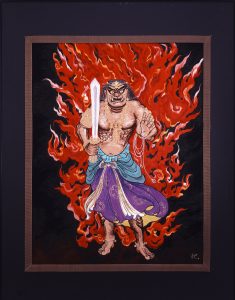
「Fierce Flame」
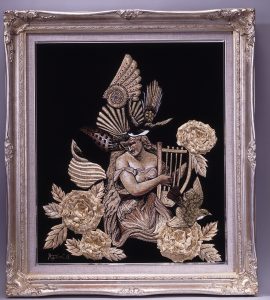
(Study)
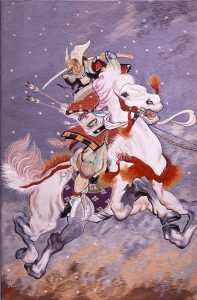
(Sengoku Warlord)
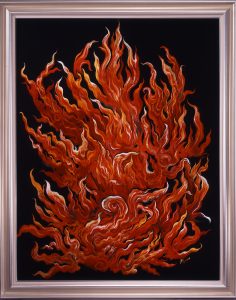
(Vitality)
コメント