"Looking back on it now, I think it was reckless,"
Ms. Osawa says . By "reckless," she refers to the fact that, less than a week after the director of Aiseien left, she picked up a pen to begin sketching the design. Sketching is the preparatory work for embroidery. Ms. Osawa had become completely captivated by the "Merciful Mother Kannon" and the director, and had firmly made up her mind to stitch it.
"Was I prepared to lose my sight? Hmm, I didn’t think about things like that. Or rather, I didn't think about anything at all. All I had was this singular desire: I wanted to stitch the Merciful Mother Kannon."
No, it wasn't that she didn't think of anything. Her father, Tozaburo, who passed away in 1972, had left behind these words on his deathbed:
"I have seen the figure of Kannon."
"I remembered that, and I felt it was some kind of guidance that a job involving Kannon would come to me just as I was struggling with my illness."
Ms. Osawa resumed her work. Naturally, she kept it a secret from her doctor.
It is Ms. Osawa’s style to never draw sketches when she embroiders; the designs are all in her head. It is also her style not to follow a design exactly even if one is provided. She reinterprets the patterns through her own sensibilities, and the finished piece becomes a work unique to her.
For the "Merciful Mother Kannon," however, she abandoned these rules. It was out of respect for Kano Hogai. Or perhaps, it was a yearning for the Kannon her father had seen at the end of his life.
"Yes, I felt that this, of all things, must not become 'my' painting. I had to be, above all else, faithful to the original."
She proceeded with the work cautiously, monitoring her physical condition. It was about half a year later that she finally sat before the sewing machine.
"Are you sure you're all right?"
Her mother, Asako, asked with concern.
"I'm fine,"
She replied.
Even she didn't believe she was really "fine," but she couldn't suppress the urge to stitch. She had no other answer. From then on, her mother said nothing more.
"She must have realized that once I decided to do something, it was useless to tell me otherwise. She didn't say a word, but she must have been on edge the whole time."
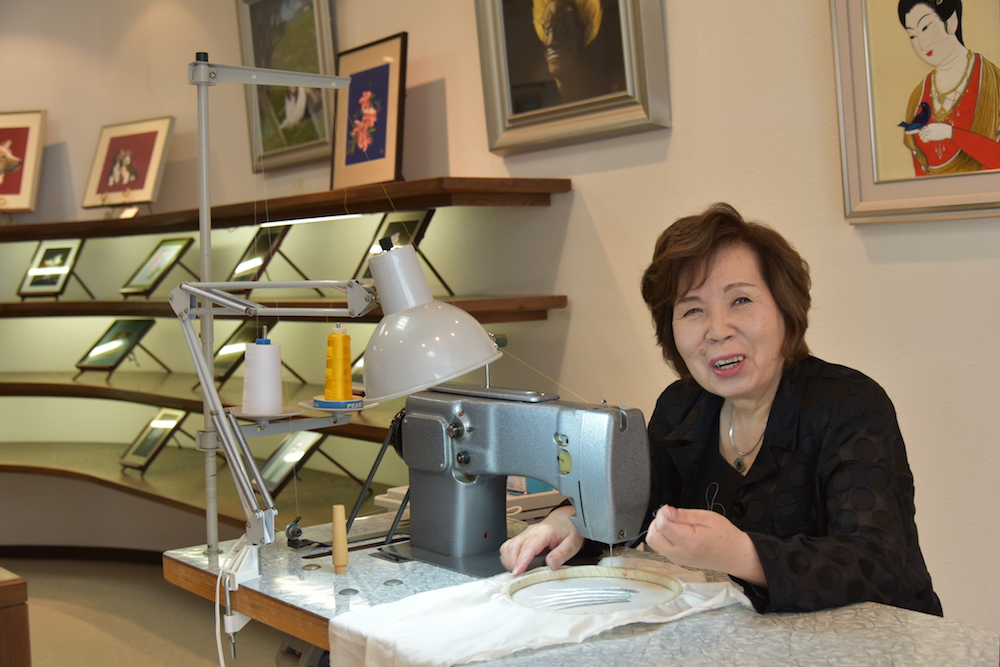
The needle of a yokoburi (swing-needle) sewing machine swings from left to right. She adjusts the width of the swing by moving a lever with her right knee. Her eyes track the needle as it continues to swing left and right while moving up and down at high speed. This is exactly what her doctor had strictly forbidden, telling her,
"You must absolutely never do this!"
But she could not embroider without tracking the needle with her eyes.
"This is bad,"
She thought. Her symptoms worsened repeatedly. Each time, she visited Gunma University Hospital.
"Ms. Osawa, aren't you pushing yourself too hard?"
The suspicious doctor would asks.
"No, I’ve been resting just as you told me,"
She would reply. She had no choice but to feign ignorance.
It took about a year at the sewing machine to complete the embroidery of the "Merciful Mother Kannon." The work is about 175cm by 100cm. Though small, it took far longer than she had expected, as she kept working in short bursts to avoid straining her eyes as much as possible. She had it framed, and it took four adults to carry it out. It was her first piece of work since falling ill, and her first income in a long time.
"Yes, financially speaking, it was like life-saving rain during a drought."
Released from the tension of the work, she went to Gunma University Hospital for a check-up.
"Ms. Osawa, you don't need to come for appointments anymore. You’re fine; the fluid leakage in your right eye has stopped. Your right eye is saved. Well, you still need to be careful, as there is a risk of recurrence. Though, truthfully, I’d like you to quit your embroidery work."
Having braced herself for the possibility of blindness to stitch the "Merciful Mother Kannon," the progression of the disease had stopped. She was told she no longer needed to go to the hospital.
"I thought the illness would only get worse, but it got better instead. That’s why it’s so strange. I'm not a particularly religious person, so I don't think it was some miracle from Kannon, but I was cured. Isn't that strange?"
After her return, Ms. Osawa changed her way of life. She had transitioned from an embroidery artisan to an embroidery artist. From then on, she only accepted creative embroidery work.
"At one point, I had even thought about committing suicide. But being able to recover from the illness made me think: 'Ah, I have no time to waste from now on.'"
This decision led to the creation of embroidery art that stands alongside paintings and sculptures. Her reputation grew, with each accolade bringing more recognition. Thus began the era in which Ms. Osawa's embroidery exhibitions were held frequently, and she became a go-to creator for numerous designers.
Kiyomi Osawa Gallery
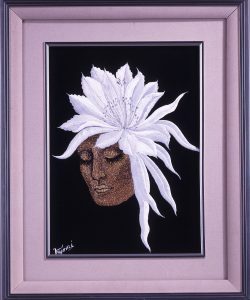
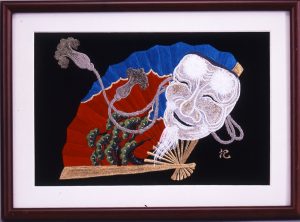
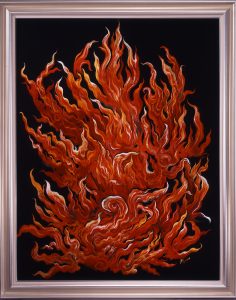
In this installment, we present the final three pieces of the "Embroidery Painting" series. The third piece, depicting blazing flames, is titled "Life" (命). One cannot help but wonder if the artist's own life burns with such intensity. The other two pieces remain untitled. Please join us next time, as we introduce five unique works that explore a different side of Ms. Osawa’s artistry.
コメント