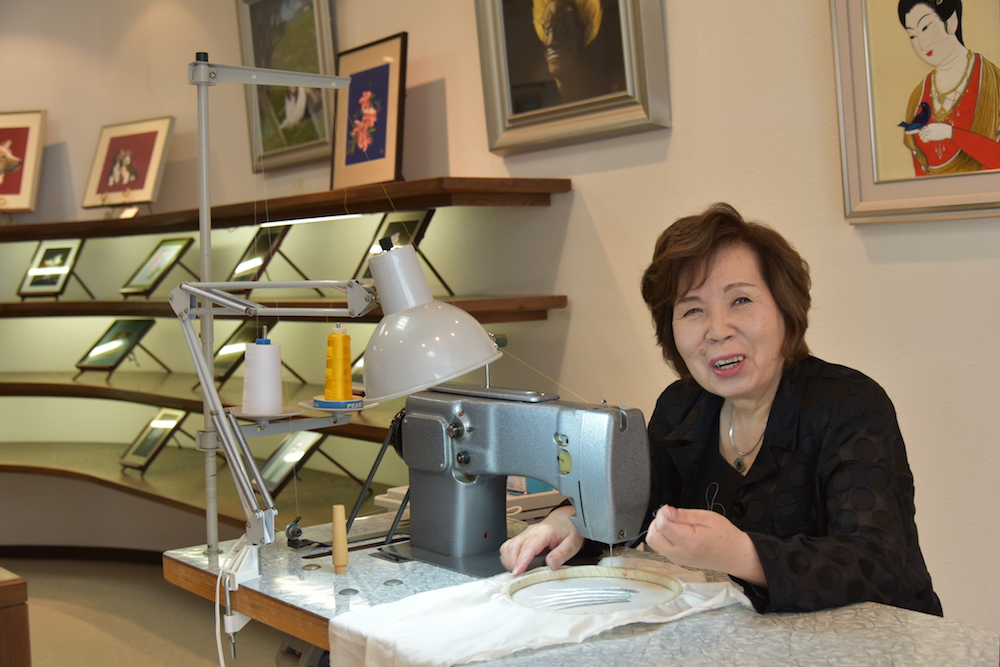
I have finished writing about the half-century of Kiyomi Osawa in the previous installment. It was quite a long series, but now that it has concluded, five photographs that I borrowed from Ms. Osawa remain unused. This is because there was no appropriate place to use them within the story I have written over twenty parts.
Fortunately, Ms. Osawa has been receiving feedback such as,
"Many stories I didn't know were revealed, and I feel a greater sense of closeness to you,"
"I didn't know, but you have had quite a remarkable life."
Furthermore, it seems the series has served as background material for television programs featuring Ms. Osawa; staff from TV Asahi who came to record in October 2018 reportedly built their program scenario based on this series. Although, as it turns out, the conversation with the host, Shuzo Matsuoka, became so lively that the program ended up ignoring the scenario the staff had prepared.
Upon hearing such feedback from Ms. Osawa, I felt it would be a shame to leave the remaining photographs unused, so I have decided to share them all.
As evidenced by the interest from TV Asahi, Ms. Osawa is a media darling. She has appeared not only in newspapers and on television but also in magazines, women's magazines, sports magazines, and even in publications for bank clients. The talents who have visited her at the request of television programs and others are diverse, including those related to Johnny's (though Ms. Osawa cannot remember who it was), comedians, and one of the twin talents, Mana and Kana (Mana and Kana Mikura).
Some programs have elicited a tremendous response; when she appeared on NHK's "Ippin," she reportedly received 80,000 hits on a website created for her by an acquaintance.
Even now, she receives three or four interview requests a year. The program with Shuzo Matsuoka is scheduled to be broadcast in November. I hope that many people will watch this program as well.
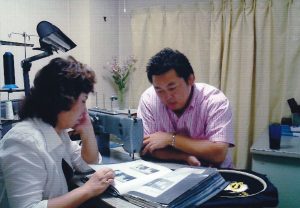
The photo below is one of those, taken when Sumo wrestler Mainoumi came to interview her. She says she cannot recall when it was, but in the photo where she is conversing with Mainoumi upon opening an album, Ms. Osawa looks quite young.
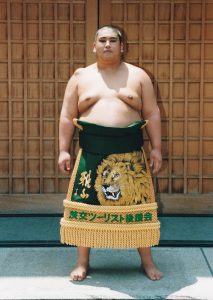
Next is the kesho-mawashi (ceremonial apron) for the sumo wrestler Miyabiyama. He is a wrestler from Mito City, Ibaraki Prefecture, and Ms. Osawa was commissioned to embroider it by his supporters. The lion, glaring at its prey with a sharp gaze, is overflowing with power down to every single whisker, making it a kesho-mawashi that could only be crafted by Ms. Osawa.
To digress for a moment, I recently watched a Chinese film titled The Banquet (released in Japan as Emperor). It is a court drama based on Shakespeare’s Hamlet. Although set in a kingdom during the Five Dynasties and Ten Kingdoms period, the interior of the palace displayed on screen was decorated so densely with numerous reliefs that there was barely any empty space. Looking at it, I rubbed my eyes in disbelief, wondering,
"Why is this so poor?!"
The eyes of the dragons crawling along the walls were dull and lifeless, as if they were dead. There was absolutely no sense of dignity. The craftsmanship looked like that of an amateur. A palace should be built with all the luxury a dynasty can muster to reflect its prestige. Are they really unable to carve anything better than this? It was truly unimpressive.
My eyes, having become accustomed to the sharp, wild gazes of dragons, lions, and tigers in Ms. Osawa’s embroidery paintings—gazes so vivid they seem ready to pounce—perceived it that way.
Returning to our story, Ms. Osawa has worked on many portrait embroideries of athletes. At the request of a Yomiuri Shimbun executive, she embroidered portraits of ON—the legendary professional baseball players Nagashima and Oh. She also created works depicting Tadashi Sawamura, who took the kickboxing world by storm, and the legendary professional wrestler Rikidozan. The portrait of Rikidozan was reportedly displayed at Riki Palace.
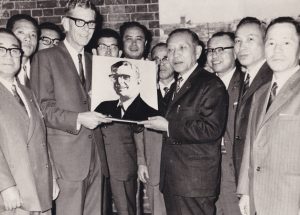
Ms. Osawa’s portrait embroidery has not only traveled to China (please refer to Episode 2), but to other countries as well. The photograph was taken when individuals involved in Kiryu’s textile industry visited Australia and brought it as a gift. It depicts the man standing on the left side of the portrait embroidery (presumably a representative of an Australian textile organization), but in reality, he is slimmer than in Ms. Osawa’s work. Apparently, he worked hard on a diet after the photograph was taken.
This is an embroidery portrait of Ebisu displayed at the Nishinomiya Shrine head office in Nishinomiya City, Hyogo Prefecture. It was commissioned by the Kiryu Nishinomiya Shrine and dedicated to the head office in September 2011 to commemorate the 50th anniversary of the restoration of the main hall. With the sky and sea rendered entirely in embroidery, the smile of Ebisu is truly full of good fortune.
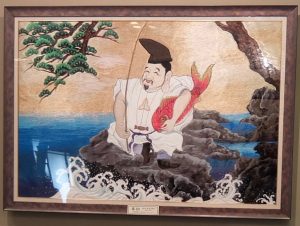
The final photograph shows the "Ebisu-sama" that Ms. Osawa decided to embroider after thinking,
"It is lonely that while the head office of Nishinomiya Shrine has one, the local Kiryu Nishinomiya Shrine does not."
She dedicated this piece to the Kiryu Nishinomiya Shrine in November 2014. Because the shrine was established by receiving a bunrei (a divided spirit) from the head office, she made this version one size smaller than the one at the head office. This embroidery is displayed on the grounds of Kiryu Nishinomiya Shrine every year during the Kiryu Ebisu-ko festival held on November 19th and 20th, so anyone can view it. I would be delighted if you could visit and see it for yourself. Ms. Osawa is the second person from the left.
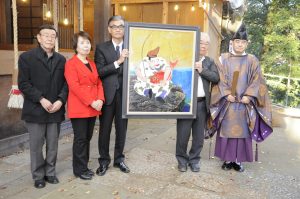
Ms. Osawa holds deep memories of the Kiryu Ebisu-ko festival. Her father, Fujisaburo, who was never home at night, would carry her on his shoulders to the festival only on the night of Ebisu-ko.
"And he didn't take my siblings; it was just me. Regardless, I was so happy to be going out at night with my father."
This embroidery painting is imbued with such nostalgic memories of Ms. Osawa.
コメント