【Yokoburi Sewing Machine (Manual embroidery machine)】
A sewing machine is an indispensable tool for dressmaking. Many people may use one for both hobby and profit. However, do you know why a sewing machine is able to sew?
A sewing machine needle has a hole (the eye) at its tip. The needle thread passes through this eye, and as the needle descends, it carries the thread through the fabric. As the needle rises, the thread remains under the fabric in a loop due to friction with the fabric. In the hidden lower part of the machine, there is a component called a "hook" (or shuttle), which catches the needle thread loop under the fabric, rotates once, and passes the lower thread, wound on a bobbin inside the hook, through that loop. This is a truly ingenious mechanism, invented in England in the 18th century. Generally called a "sewing machine," it is equipped with a mechanism to automatically advance the fabric ("feed dogs") and a "presser foot" to hold the fabric down, allowing for precise and rapid sewing.
It is said that it was the American machinist Walter Hunt who, in the mid-19th century, added the function of moving the needle side-to-side, which had previously only moved up and down. Eventually, after successive improvements, the zigzag sewing machine (also called a blind stitch machine) was born. Because the width of the stitch can be adjusted in advance, it is still used today for hemming trousers and finishing fabric edges. This became the prototype for the "Yokoburi sewing machine."
To do embroidery with a sewing machine, one must be able to move the fabric being sewn freely. To achieve this, one must first remove the "feed dogs" and "presser foot" from a zigzag machine so that the fabric can move at will. Furthermore, a mechanism is needed that can freely adjust the needle's swing width, which was fixed on a standard zigzag machine. There was a person in Kiryu who built such an improved sewing machine. This is said to have been during the Taisho era, but unfortunately, their name has not been recorded. This machine is called a "Yokoburi sewing machine." While multiple companies manufactured them when the domestic textile industry was thriving, JUKI is the only remaining manufacturer today.
So, why was the "Yokoburi sewing machine" invented in Kiryu? According to Kiyomi Osawa, an embroidery artist in Kiryu, a massive amount of obi (kimono sashes) was woven in Kiryu when it prospered in the textile industry. Unlike other obi production areas, many of Kiryu's obi were plain, and embroidery artisans would decorate them by hand. Because it was all manual work, productivity was low, and the finished obi were expensive. "They must have been trying to do something about that," says Ms. Osawa. However, just like the inventor's name, no documentation on this matter has been found.
【The Sewing Machine Artisan Surprised】
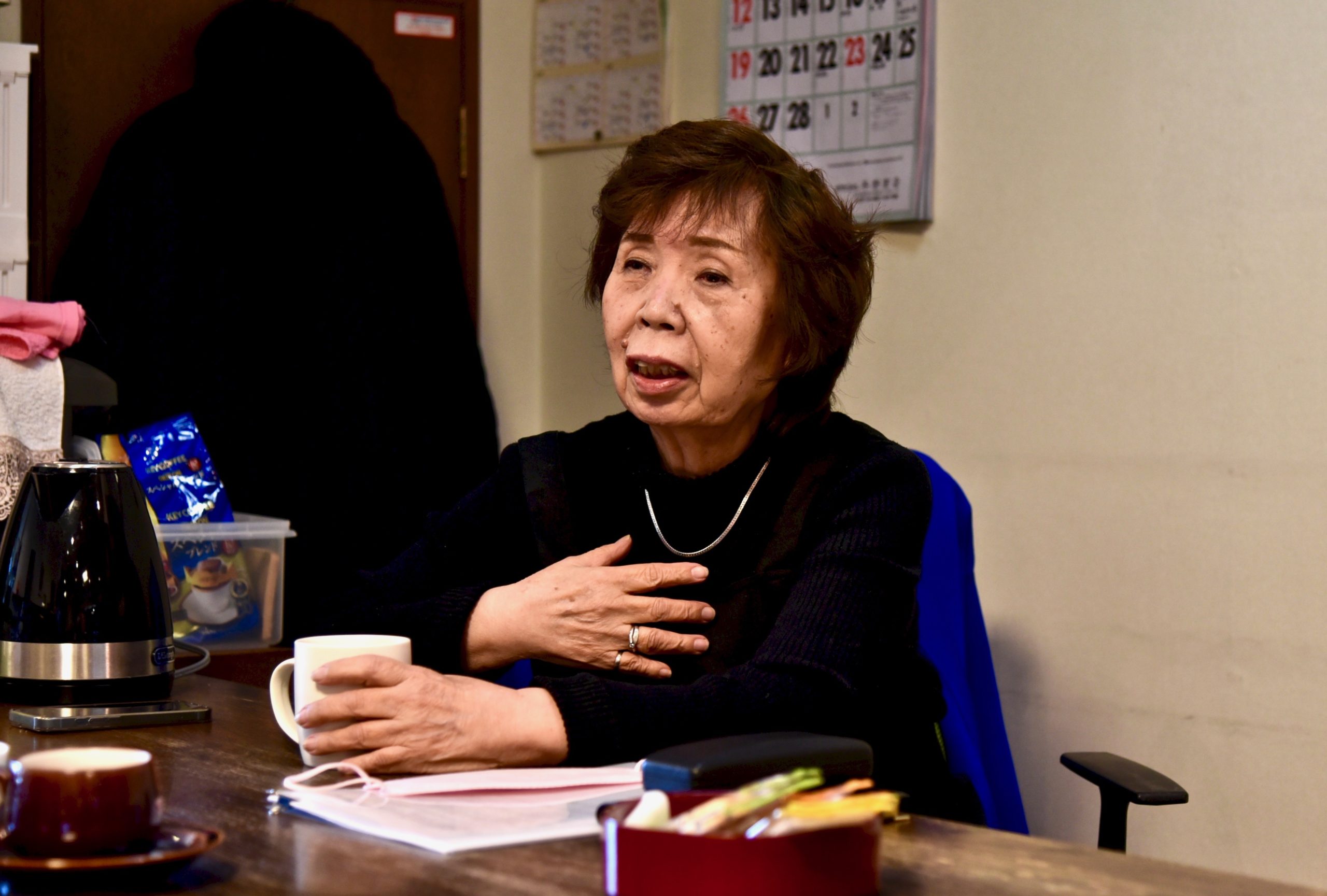
I introduced Ms. Osawa in "The Sewing Magician: Kiyomi Osawa" as an embroidery artist who elevated embroidery to an art form. I believe some of you may have read it.
This time, I would like to introduce Ms. Osawa from a slightly different perspective: Ms. Osawa as a sewing machine artisan.
It happened when she was in her twenties, running a workshop with about 30 female workers. Frequent "skipped stitches" began to occur on several machines. A skipped stitch is an accident where the needle thread passing through the fabric does not interlock with the lower thread and ends up hanging loosely.
While embroidery artists and artisans are knowledgeable about embroidery, their knowledge of the sewing machines used as tools is often shallow. If a sewing machine breaks, it is normal to ask a professional sewing machine technician for repairs. Ms. Osawa called in her regular sewing machine technician.
Since the upper thread was not interlocking with the lower thread, the rhythm between the needle and the hook must have been off. The technician sat in front of the broken machine, took out the hook, and did something. When the repair was finished, the technician began to embroider.
"Ms. Osawa, it's fixed."
The technician went back. A worker started sewing.
"Oh, it skipped a stitch again!"
Even though it should have been fixed, it still skipped stitches frequently. She called the technician back again. It returned to normal while they were there, but as soon as the technician left, the skipped stitches recurred. This is strange. Is the machine trying to cater to the technician?
She tried using the machine herself. First of all, the sound was different. The usual pleasant sound sounded somehow "dirty." Moreover, the feeling of moving the embroidery hoop holding the fabric did not feel quite right either.
Why?
This happened repeatedly. If the technician couldn't fix it, she had to do something herself, or the work wouldn't get done. When the technician sat in front of the machine, it worked normally. When the worker sat down, it didn't. What on earth was the difference?
Suddenly, she thought,
"Is it their weight?"
No matter how she thought about it, there were no other differing conditions. Once she had the idea, she had no choice but to try it. What changes with the weight of the person sitting in front of the sewing machine?
The Yokoburi sewing machine is also mounted on a wooden stand. The stand is made of a tabletop and a leg frame, with rubber cushions sandwiched in between. Perhaps those rubber cushions were damaged, causing distortion due to the difference in the weight of the person using the machine?
Ms. Osawa removed the rubber cushions and tried inserting felt instead. She operated the machine herself. No skipped stitches. She continued to sew. Still, no skipped stitches. When the worker took over, the skipped stitches stopped happening entirely.
"In the end, the horizontal leveling was off. The Yokoburi sewing machine is an incredibly sensitive piece of machinery," she said.
When the sewing machine technician came next, she told them that the skipped stitches had stopped. The technician was surprised, saying, "Huh, the leveling. I've been making a living at this job for a long time, but I never even thought of that. That's a shock."
Since then, a level (spirit level) has been an essential item for Ms. Osawa. When a sewing machine's condition is off, she uses this level to check the horizontal balance.
"Well, I use an iPhone for that now, though. Yes, I still have the level, too," Ms. Osawa laughed.
Photograph: Kiyomi Osawa
コメント