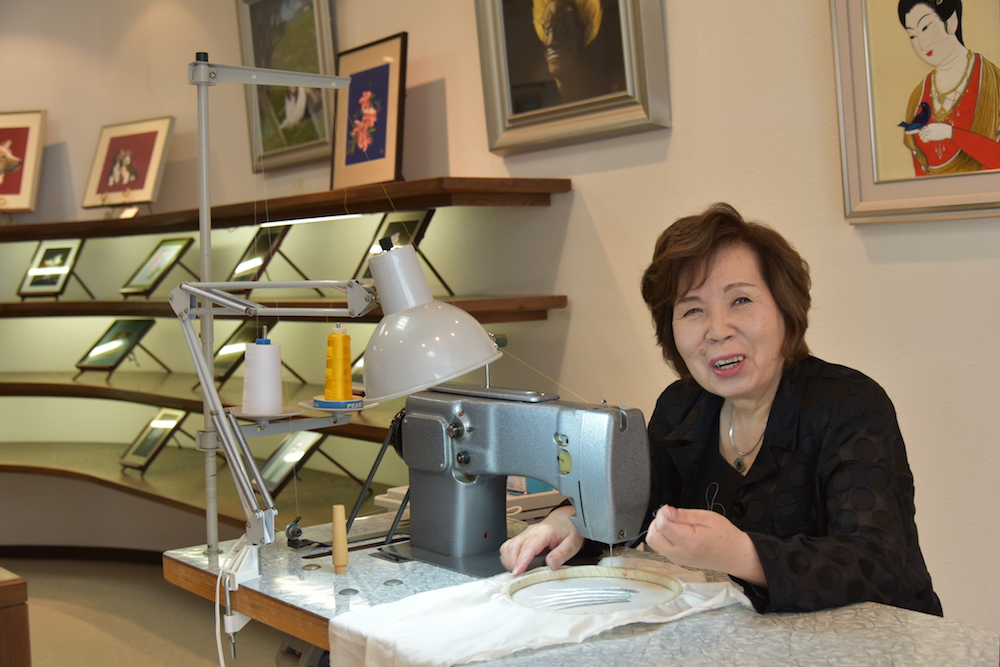
Sharpness of gaze, the changing expression of the eyes depending on how the light hits them, the beauty of the fur, the natural flow of the hair—Osawa’s embroidery paintings possess a number of features that leave others in the dust.
These may be characteristics that only become clear when compared with the works of others. However, there is one thing that anyone can notice immediately:
Most of Osawa’s embroidery paintings are finished with the background fully embroidered as well. To my knowledge, there is no other example of this. In most cases, the fabric is either left exposed or painted with other materials. Yet, from the moment she depicted a portrait of Kim Novak at the age of 19, Osawa has been rendering even the backgrounds with embroidery thread.
"Isn't that easy if you know how to embroider?"
Some of you might think so. However, finishing a wide space with embroidery is not as simple as one might think.
For instance, suppose you decide to create a background with just one color. If you were using paint or crayons, you would simply fill it in. But with embroidery, the expression changes depending on the direction and layering of the threads. When light hits it, it reveals yet another face.
Even if you decide,
"I will use this color for the background,"
If the direction of the threads is off by even the slightest amount, it becomes a completely different background.
"Breadth" is also an issue. To embroider, the fabric is fixed in a circular wooden frame about 30 cm in diameter. What can be sewn by the sewing machine at one time is only the circle within this frame. When finishing this part and sewing the adjacent circle, the direction of the threads must be connected to the part that has already been sewn. Troublesomely, the human eye can distinguish even the most subtle differences. If the angle is off even slightly, the eye will detect a seam there.
In addition, adjusting the wooden frame is a difficult challenge. The frame is double-layered; the fabric is placed over the inner frame and secured with the outer frame. At this time, the fabric must be stretched with more tension in the vertical direction and less in the horizontal. The way it is stretched is the problem—if it is stretched too tightly, the fabric will shrink when the frame is removed, causing bumps and distortions in the embroidery. If the tension is insufficient, it is difficult to embroider. To embroider a wide area like a background, one must stretch the fabric with the exact same tension every time; otherwise, one part may end up with bumps and unevenness, while another part may be loose and lack definition.
That was something the 19-year-old Osawa understood all too well. Although it had been only two years since she started at 17, she had been working with a manual embroidery machine for around 20 hours a day. She was well aware of the difficulty of filling a wide space with embroidery thread. That is why one could say no one had attempted it before.
Yet, she does it anyway. If she didn't, the artistic soul burning within Osawa would begin to rage.
"After all, the texture of embroidery thread and fabric is completely different from that of embroidery thread and paint. If you don't finish the background with embroidery, the painting won't have a sense of unity. It wouldn't be worthy of being called a 'work of art.'"
Let me show you an example.
The photos below are both works by Osawa. Both depict Kannon (the Goddess of Mercy). On the left, the background was not sewn; the beige color is the color of the fabric itself.
On the right, while depicting the same Kannon, the background was also embroidered. Distant mountain ranges continue into the distance, and the sky, where clouds drift, is tinged with golden hues, perhaps from the sunset. The intensity varies from place to place, showing a diverse range of expressions. The transparent lace stole also comes to life only because of this background.
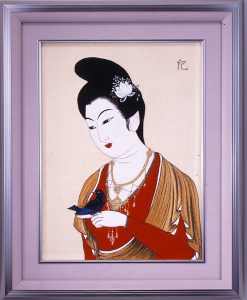
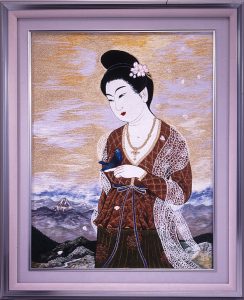
I wonder which Kannon the readers would judge to be superior?
For the background of the Kim Novak portrait, Osawa chose a deep, monochromatic green to match the color of her eyes. For the 19-year-old Osawa at the time, that was the ultimate challenge.
The backgrounds Osawa stitches today include multi-colored gradations. One could say the monochrome background she filled in for Kim Novak was the simplest form of embroidery.
Nevertheless, it was something no one had ever attempted before. How many pieces did she fail on?
"No, not a single one. Yes, I was able to stitch the background exactly as I had imagined it right from the start."
Today, not even a photograph remains of that Kim Novak piece. Am I the only one who feels a chilling fascination for it and wishes I could see it just once?
Kiyomi Osawa Gallery
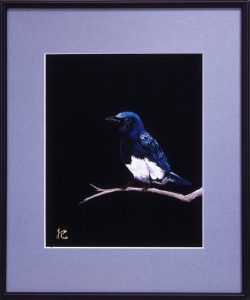
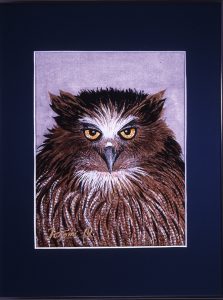
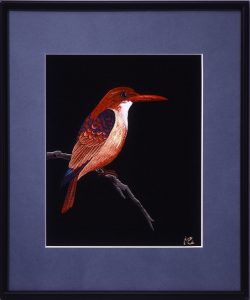
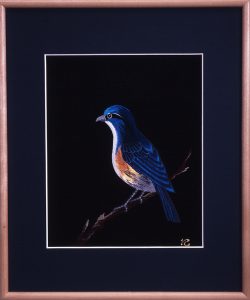
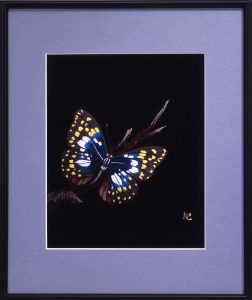
This time, we will show you the remaining embroidery pieces featuring "birds." None of these works have been given titles. The fifth piece is a butterfly, but I have decided to include it here as a flying creature.
コメント